

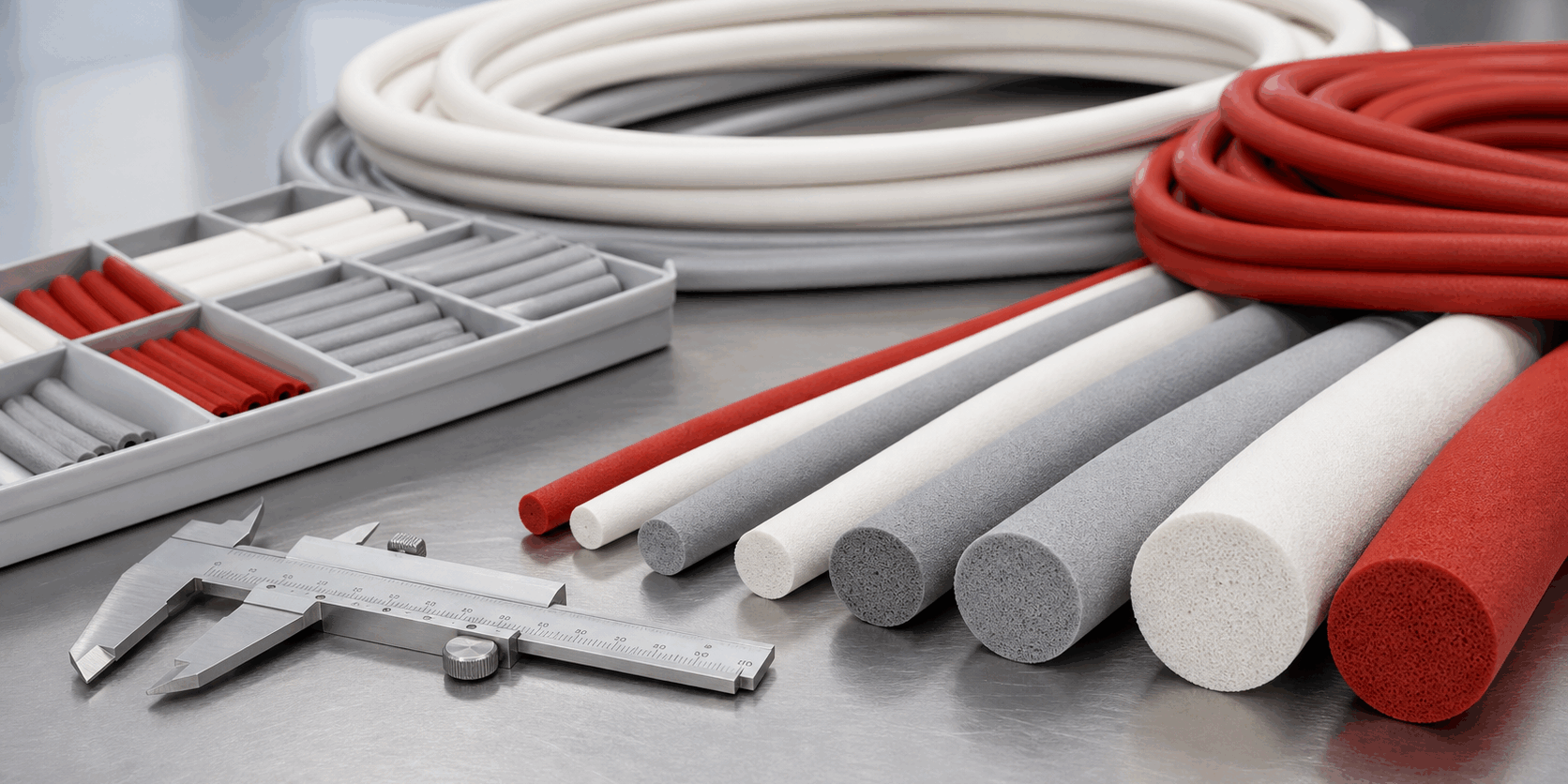
Self-adhesive sponge rubber: silicone foam seals with adhesive tape
Self-adhesive silicone sponge rubber is the right choice when a seal needs to operate continuously above approximately +100 °C, in extreme cold or in contact with food. For food contact, this applies where the compound’s suitability has been documented. For many outdoor applications at moderate temperatures, EPDM sponge rubber is the more economical solution. PU foam is mainly used indoors at room temperature and under low loads. However, whether the seal stays in place in a production component depends just as much on the adhesive system. Silicone can only be bonded reliably with conventional acrylic adhesives after pretreatment, or using a double-sided tape with a silicone adhesive on the foam side. The adhesive on the mounting side is selected according to the substrate and temperature.
Material selection: silicone foam, EPDM sponge rubber or PU foam
Depending on the compound, silicone foam can typically be used at temperatures from approximately -60 °C to +200 °C, with some grades suitable for higher temperatures for short periods. EPDM sponge rubber typically has a continuous service temperature range of approximately -40 °C to +100 °C and offers good weathering and ozone resistance. PU foams are generally designed for temperatures up to approximately +80 °C, and polyester PU can hydrolyse under warm, humid conditions.
If an EPDM seal remains within its permitted temperature range and there is no food contact requirement, it is generally the more economical solution. Silicone foam is worthwhile where temperature peaks result from heating elements, power electronics or cleaning with hot water and steam. It is also worthwhile when the seal needs to retain reliable recovery properties after years of use. The compression set of closed-cell silicone foam at elevated temperatures is generally lower than that of EPDM or PU foam. Specific values depend on the compound and test conditions and are provided in the data sheet for the relevant silicone foam grade.
Acrylic or silicone adhesive: selection by temperature and substrate
Silicone has a low surface energy. A standard acrylic adhesive tape adheres poorly to untreated silicone foam and may detach when the liner is removed or after the first temperature cycles. In series production, either a double-sided tape with silicone adhesive on the foam side and acrylic adhesive on the mounting side is laminated onto the foam, or the foam surface is pretreated with a primer or corona treatment before lamination.
Acrylic adhesives on the mounting side achieve high bond strength on metal, glass and many painted surfaces. They typically withstand continuous service temperatures up to approximately +100 °C and, depending on the product, short-term temperatures up to approximately +150 °C. PP, PE and some powder coatings require a modified acrylic adhesive or a primer.
Depending on the tape, silicone adhesives are designed for higher temperatures than acrylic adhesives and also adhere to silicone-containing or silicone-coated surfaces where acrylic adhesives fail. Their initial tack on metal is generally lower. The adhesive type alone does not determine the approved temperature range, as silicone tapes also vary considerably in their continuous and short-term temperature ratings. If the seal operates continuously above approximately +100 °C, the specific tape is selected using its data sheet to match the temperature, load and substrate, and then tested on a sample. At room temperature on sheet steel or aluminium, a combination of silicone adhesive on the foam side and acrylic adhesive on the mounting side is often sufficient.
Profile, round cord or die-cut part: geometry determines the bonding area
Adhesive tape requires a flat contact surface. On rectangular, D-shaped and P-shaped profiles and on flat strips, it is laminated across the width of the base. A round cord only makes contact along a narrow line, leaving a correspondingly weak bond. If a rounded sealing contour needs to be bonded, a D-shaped profile with a flat base provides a more secure solution. The overview of silicone profiles shows the available cross-sections.
Die-cut parts are manufactured from adhesive-laminated sheets and are usually supplied kiss-cut on the liner so that they can be peeled off individually. For frame seals cut from sheet material, the centre cut-out becomes scrap. For large frames, a profile with a butt joint or a vulcanised frame therefore often uses less material. The article on silicone seals in industry provides an overview of flat gaskets, moulded seals and profile seals.
Requirements for control cabinets, enclosures and food processing equipment
Control cabinets and electronics enclosures often require a degree of protection according to IEC 60529, such as IP54 or IP65. The degree of protection applies to the tested enclosure as a whole; the seal alone does not have an IP rating. Key design factors are closed-cell foam, uniform compression around the entire perimeter and a leak-tight butt joint. If a flammability rating according to UL 94 is required, the specific foam grade must have the corresponding classification. This does not automatically apply to every silicone compound.
For food contact, silicone foam compounds are available that comply with BfR Recommendation XV or meet the requirements of FDA 21 CFR 177.2600 for rubber articles intended for repeated use. Regulation (EC) No. 1935/2004 establishes the legal framework in the EU. Adhesive tapes generally do not have their own food contact compliance documentation. The adhesive side must therefore be positioned outside the product contact zone, and this should be explicitly specified in the drawing.
Common installation and material selection errors
The most common installation error is stretching the profile while applying it. The stretched foam later contracts, leaving gaps at butt joints and corners. Profiles should be laid in place without tension, with a slight excess length at butt joints. An unclean substrate is equally critical, as oil, release agents and dust prevent wetting. Standard practice is to clean with isopropanol, allow the surface to dry completely and apply uniform pressure. Many tape manufacturers specify an application temperature of at least approximately +15 °C.
Designs often specify excessive compression. In practice, closed-cell foam is usually compressed by approximately 20 to 50 % of its original height. Beyond this, closing force and compression set increase, and thin sheet metal covers may distort. Another common mistake is selecting a foam that is too dense and firm in an attempt to compensate for large tolerances. Where the gap varies considerably, a softer foam with a greater original height is usually the better choice.
Information required for an enquiry based on a drawing
For a production part, the manufacturer needs the following information:
• Cross-section or die-cut outline with tolerances
• Foam type, density or compression hardness
• Temperature range during operation and cleaning
• Substrate material and surface finish
• Adhesive system or the requirement used to select it
• Required compliance
For profiles, the supplied length, supply as rolls or straight lengths, and tape position must also be specified; for die-cut parts, specify supply on sheets or rolls.
If substrate information is missing, a standard tape is often selected that subsequently fails to adhere to powder-coated surfaces or plastic. Before series production starts, samples should be approved on the actual component under real operating temperature and cleaning conditions.
Frequently asked questions
Is sponge rubber always closed-cell?
In common usage, sponge rubber mainly refers to closed-cell or mixed-cell foam rubber. Open-cell foams absorb water and are more suitable for dust protection or cushioning. For seals exposed to splashing water or cleaning agents, a closed-cell structure should be explicitly required in the drawing.
Does the foam or the adhesive tape limit the service temperature?
In self-adhesive seals, the adhesive tape usually limits the service temperature. Depending on the compound, silicone foam typically withstands around +200 °C, whereas an acrylic adhesive typically withstands only approximately +100 °C continuously. The lower rating of the two components therefore governs the design.
Can a self-adhesive profile be fitted around corners?
The profile can be fitted around corners with large radii. At tight corners, the liner or tape wrinkles on the inside, reducing the bonding area. In these locations, profiles are usually mitre-jointed, notched on the adhesive side or supplied as a vulcanised frame with finished corners.
Can a self-adhesive silicone foam seal be reused after removal?
These seals are generally not intended for reinstallation. During removal, the adhesive picks up dirt or remains partly on the substrate, and the foam may tear. For maintenance covers that are opened regularly, the seal should be bonded to the cover and seal against a smooth mating surface.
When can the adhesive bond withstand its full load?
Acrylic adhesives typically reach their final bond strength after 24 to 72 hours at room temperature. During this time, the adhesive flows into the surface irregularities. If the component is exposed to high temperatures, shear forces or cleaning before this period has elapsed, the seal may detach. Sample testing should allow sufficient time for the adhesive to reach its final bond strength.