


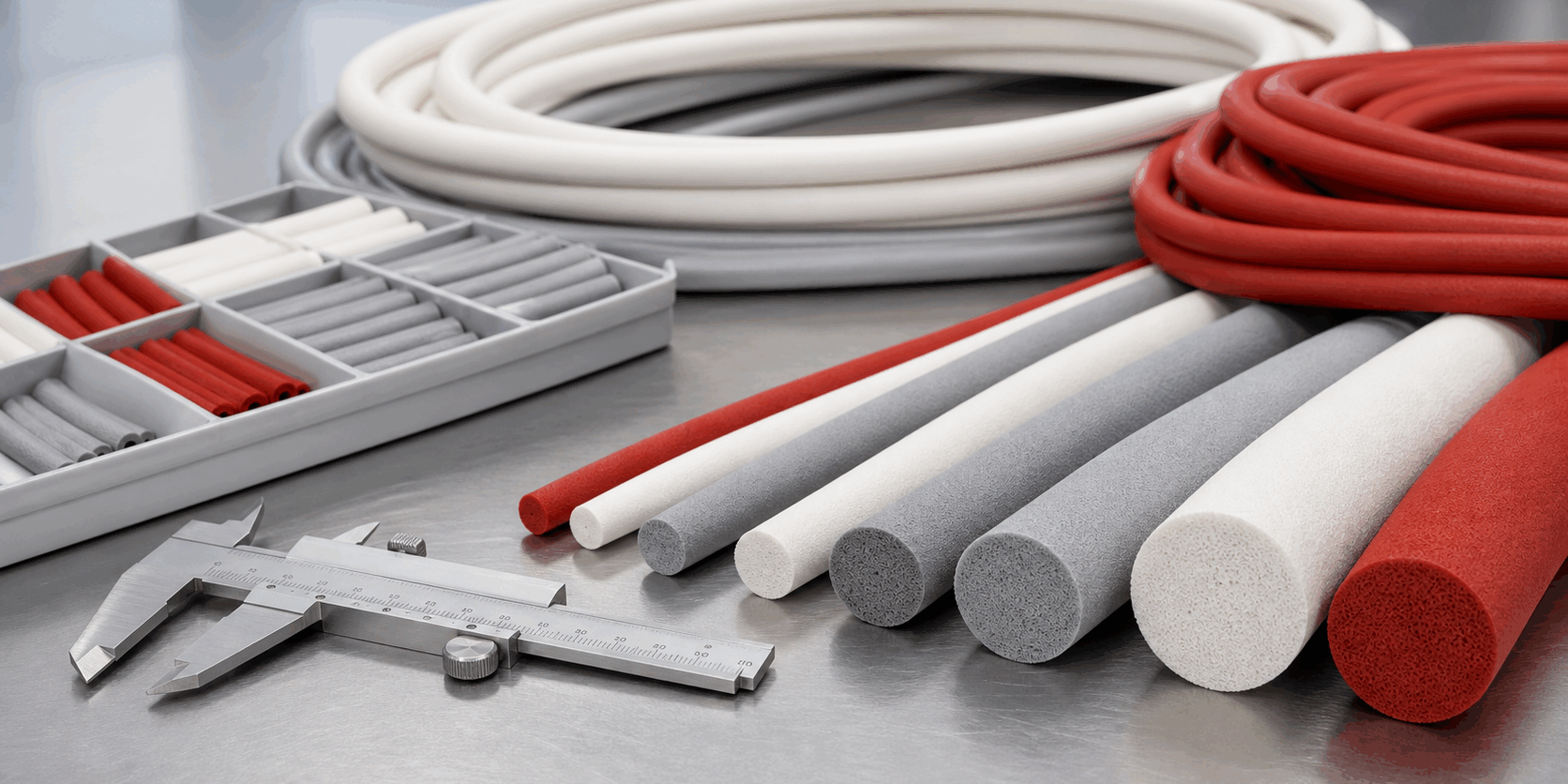
Silicone foam sponge rubber seal: profiles for housings and doors
A sponge rubber gasket made of silicone foam is the right choice when temperatures above 120 °C, food contact or low closing forces with low compression set are required. For applications at room temperature without special requirements, profiles made of EPDM or CR cellular rubber are often sufficient. The requirements change as soon as a machine door is regularly cleaned hot, a control cabinet is located outdoors or a cover has to remain sealed for years with low contact pressure. This article compares the materials, explains the difference between closed-cell and open-cell foam and shows which characteristic values belong in the drawing when specifying a sponge rubber gasket.
Silicone foam, EPDM or CR: selection according to operating conditions
Sponge rubber is an elastomer that is foamed by blowing agents during vulcanization. It is usually mixed-cell, so it contains open and closed cells, and as an extruded profile it has a dense outer skin. Cellular rubber, by contrast, is predominantly closed-cell. In everyday usage, the two terms are often mixed, but the actual cell structure is what matters for the specification. EPDM sponge rubber is typically designed for continuous temperatures up to about 120 °C, with peroxide-cured grades up to about 150 °C. The material is resistant to ozone, weathering and water, but swells in mineral oils and greases. CR sponge rubber made of chloroprene is typically rated for about 100 °C continuous temperature. It is moderately resistant to oils and is formulated as flame-retardant in many compounds.
Silicone foam covers a range from about -60 °C to +200 °C depending on the compound, with individual grades tolerating higher temperatures for short periods. It remains flexible in cold conditions and is resistant to ozone and UV radiation. Formulations for food contact are available. Silicone has limitations with mineral oils, fuels and long-term exposure to hot steam. Where oil is the most important contact medium, CR or an oil-resistant special material remains the better solution.
Closed-cell or open-cell
In closed-cell foam, the individual cells are separated from one another. The material absorbs little water and seals against dust and splash water when compressed. Extruded sponge rubber profiles also have a closed outer skin, which further reduces water ingress. In die-cut parts from sheets, however, the cells are open at the cut edges. This must be taken into account in applications with standing water.
Open-cell silicone foam has interconnected pores. It is very soft and can be compressed with little force. It is suitable for damping, tolerance compensation and contact pressure functions. As a seal against water, it is only suitable to a limited extent because it absorbs liquid. For dry indoor applications, such as dust protection on device covers, it is an option with particularly low closing force.
Density and closing force
The density of silicone foam is typically between about 0.2 and 0.6 g/cm³ depending on the compound and process. Solid silicone, by contrast, is typically about 1.1 to 1.3 g/cm³. As density decreases, compression hardness also decreases, meaning the force required for a defined deformation. It is usually specified in kPa at 25 % or 40 % compression. For designers, it is the decisive value when hinges, latches or magnetic locks can only apply limited forces.
Closed-cell sponge rubber gaskets are typically compressed by 25 to 50 % of their height. If compression is too low, the gasket leaks as soon as the gap dimension fluctuates. Excessive compression increases compression set and can permanently destroy cells. The drawing should therefore specify the profile cross-section, density or compression hardness, target compression and the tolerance of the sealing gap together. If the required closing force cannot be achieved even with foam, hollow chamber profiles made of solid silicone are an alternative. There, the geometry determines compliance, not the cell structure.
Compression set and temperature range
Compression set indicates what proportion of a deformation remains permanently after unloading. For cellular materials, it is often tested in accordance with ISO 1856, for example at 50 % compression over 22 hours at elevated temperature. Above about 100 °C, silicone foam shows a significantly lower compression set than EPDM or CR sponge rubber depending on the compound. Post-curing after vulcanization further reduces the value and lowers volatile components.
For the specification, the compression set at operating temperature is more meaningful than a value at 23 °C. The cold side is also important: EPDM and CR become stiffer at low temperatures. A door gasket used outdoors then recovers less effectively. Silicone foam remains flexible down to about -60 °C depending on the compound.
Self-adhesive backing and installation
Silicone typically has low surface energy. Adhesives therefore only bond if the foam side is pretreated or if an adhesive tape based on silicone adhesive is used. Acrylic adhesives are typically suitable for continuous temperatures up to about 100 to 120 °C and bond well to metal and painted surfaces. Silicone adhesives withstand continuous temperatures up to about 200 °C depending on the product and also adhere to silicone-coated substrates.
The bonding surface must be clean and free of grease. Many adhesive tapes only reach their final strength after 24 to 72 hours and should not be applied below about +10 °C. The adhesive tape manufacturer’s specifications are decisive. The bond mainly serves positioning. On doors where lateral insertion loads the gasket in shear, a groove or clamping profile is often safer. A groove and adhesive bonding can also be combined.
Applications in control cabinet construction, food technology and vehicle engineering
In control cabinet construction, closed-cell sponge rubber gaskets contribute to the degree of protection according to DIN EN 60529, for example IP54 or IP65. The degree of protection is always verified for the complete enclosure. For outdoor enclosures, UV and ozone resistance support the use of silicone. In food technology, compounds are used that comply with BfR Recommendation XV or meet the requirements of FDA 21 CFR 177.2600 for rubber articles intended for repeated use. A smooth, closed outer skin absorbs less moisture and cleaning agent than open cut surfaces.
In vehicle engineering, silicone foam gaskets are used on battery housings, flaps and service openings. For rail vehicles, fire protection requirements according to EN 45545-2 apply, and special silicone foam compounds are available for these applications. An overview of sheets, cords and profiles is provided on the page about silicone foam. The article on silicone gaskets in industry explains how sponge rubber is classified compared with O-rings, flat gaskets and molded gaskets.
Frequently asked questions
What is the difference between sponge rubber and foam rubber?
Sponge rubber is usually mixed-cell and, as an extruded profile, has a dense outer skin that seals against water and dust. Cellular rubber is predominantly closed-cell and absorbs little water even at cut edges. Foam rubber is generally open-cell and very soft. It absorbs liquid and is more often used for damping and cushioning.
How much should a sponge rubber gasket be compressed?
Closed-cell sponge rubber gaskets are typically compressed by 25 to 50 % of their height. The specific value depends on density, profile cross-section, gap tolerance and operating temperature. Permanent compression beyond the recommended range increases compression set.
Is a silicone sponge rubber gasket suitable for food contact?
That depends on the compound. For food contact, silicone foams are used that comply with BfR Recommendation XV or meet the requirements of FDA 21 CFR 177.2600. Suitability is confirmed for the specific formulation, not generally for silicone.
Which adhesive is suitable for self-adhesive silicone sponge rubber profiles?
Acrylic adhesives are typically suitable up to about 100 to 120 °C continuous temperature and bond well to metal and paint. Silicone adhesives are used for higher temperatures or silicone-containing substrates. Suitable silicone pressure-sensitive adhesives bond to the silicone foam without activating pretreatment, while acrylic adhesives require it depending on the system. In all cases, the bonding surfaces must be clean and free of grease.