

Silicone Seals in Industry: O-Ring, Flat and Molded Seals – Selection Guide for Designers
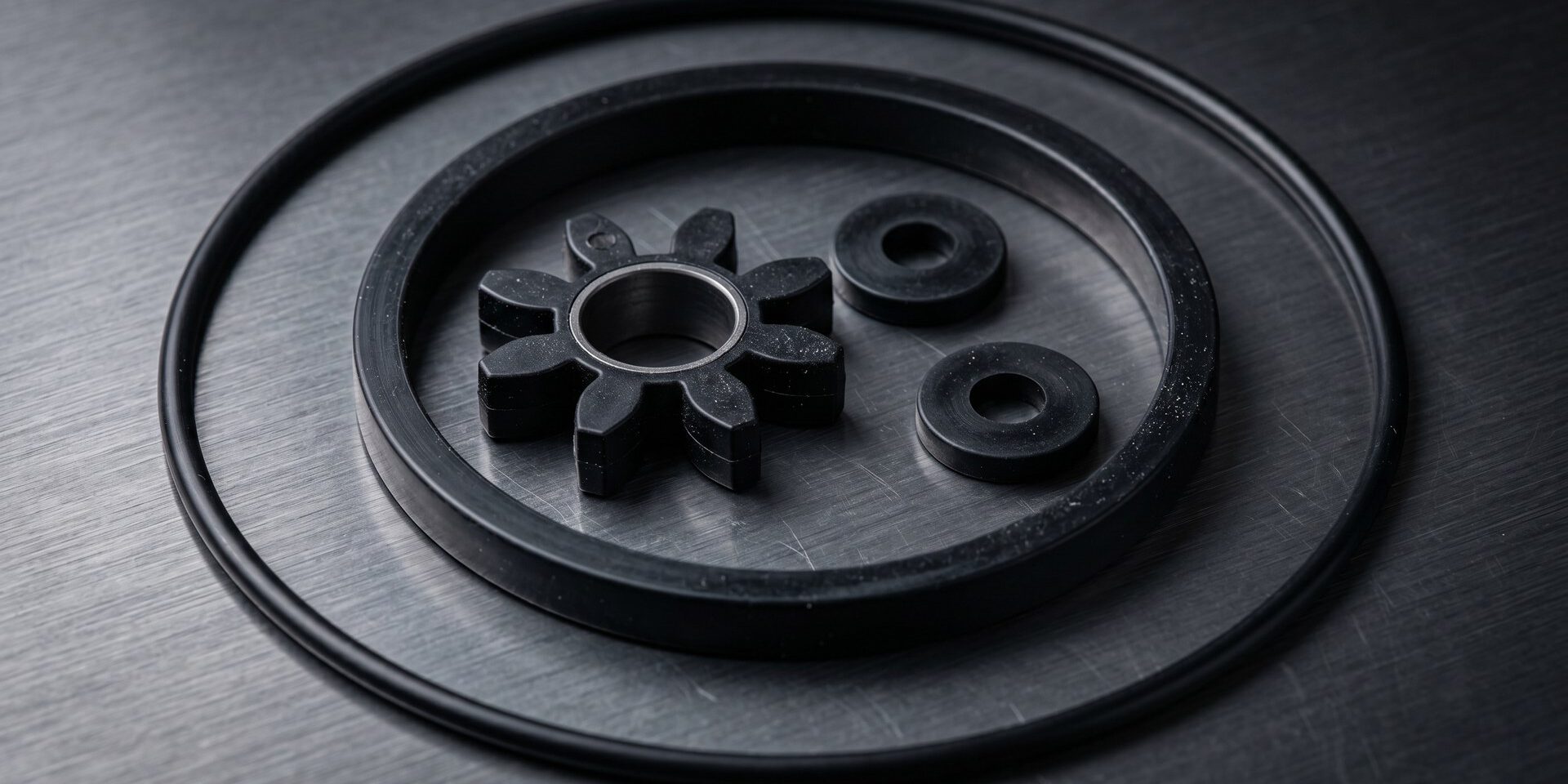
Short answer: Silicone seals are the first choice in industry whenever a component requires extreme temperature range (–50 °C to +200 °C / +250 °C), excellent electrical insulation, food or pharmaceutical contact, or permanent UV and weather resistance. The three most important industrial designs are O-rings (static/rotary, tolerances according to ISO 3601), flat seals (flanges and component joints), and molded seals (complex geometries, often manufactured by injection molding). The selection follows a clear scheme: medium > temperature > pressure > geometry > hardness > approval.
Designers, purchasers, and maintenance personnel often face the same question: Which silicone seal is suitable for my application – and how does silicone differ from EPDM, NBR, or FKM, which are already listed in many specifications? This guide categorizes the options by design, material, and industrial requirement – with a focus on reliable selection criteria instead of marketing formulations.
Comparison of the three industrially relevant designs
| Design | Typical Function | Tolerances / Standard | Economical Sweet Spot |
|---|---|---|---|
| O-ring | Static and simple dynamic sealing tasks in grooves | Dimensions & Tolerances ISO 3601-1; Material Requirements ISO 3601-3 | Series parts, large quantities, standardized grooves |
| Flat seal | Sealing between flat surfaces (flanges, covers, sight glasses) | Geometry according to design, material according to DIN/EN 1514, ASTM F104 | Piping, apparatus construction, machine housings |
| Molded seal | Complex geometries, multi-functional seals, undercuts | Tooling capability, tolerances according to DIN ISO 3302-1 (M-classes) | Injection molding for medium to high quantities |
Silicone, EPDM, NBR, FKM – when to use which material?
The most important elastomers in industrial sealing applications differ primarily in temperature range, media compatibility, and compression set:
| Material | Continuous Operation | Strengths | Weaknesses |
|---|---|---|---|
| Silicone (VMQ) | −50 … +200 °C (HT up to +250 °C) | Temperature range, UV/ozone, food/medical grade, cleanroom, electrically insulating | Limited resistance to mineral oils/fuels, lower tear strength than organic elastomers |
| EPDM | −40 … +130 °C | Steam, hot water, ozone, many aqueous acids/alkalis | Not resistant to mineral oils and fuels |
| NBR | −30 … +100 °C | Resistant to mineral oils, fuels, hydraulic oils | Poor weather/UV resistance, limited temperature range |
| FKM (e.g., Viton) | −20 … +200 °C | Aggressive chemicals, fuels, high temperatures | High price, poor low-temperature performance, limited resistance to hot water/steam |
| FVMQ (Fluorosilicone) | −55 … +175 °C | Silicone advantages + resistance to mineral oils/fuels | Higher price, smaller temperature range than standard VMQ |
We have documented a detailed comparison in Silicone vs. EPDM – complete comparison.
Silicone O-ring: Design in practice
A silicone O-ring should be installed in a groove dimensioned according to ISO 3601-2. Rules of thumb for static applications:
- Compression: 15–25 % of the cord thickness for static, 8–16 % for dynamic (rotating) seals.
- Groove fill: 60–85 %, to accommodate swelling in the medium.
- Hardness: 50–70 Shore A for most applications; 70–80 Shore A for higher pressures.
- Compression set (DVR, ISO 815): Value < 25 % after 70 h / 100 °C is a good standard for static sealing tasks.
For dynamic applications (slowly rotating shafts, pistons with small strokes), silicone O-rings are technically possible, but the friction conditions are different from NBR – check lubricant selection, possibly fluorosilicone-based.
Silicone flat seals: Contact pressure and compression set
Silicone flat seals are used in flanges, cleaning hatches, inspection covers, sight glass holders, and similar locations. Material selection follows three rules:
- Surface pressure at design temperature: Silicone has lower strength than NBR or EPDM. Design surface pressures are typically 0.5–3 N/mm² (Shore A 50–80).
- Consider compression set: Compression set increases over time. Retighten tightening torques after maintenance if necessary.
- Geometry: Inner and outer edges must be deburred in the design, otherwise predetermined breaking points will occur at the transition.
Molded seals: when standard geometry is not enough
Molded seals are manufactured by injection molding or compression molding and cover all geometries that a standard O-ring or punched part cannot achieve: rectangular frame seals, seals with integrated sealing lips, multiple sealing planes in one component, or hybrid seals with integrated metal or plastic inserts.
The choice between the processes depends on the component: Injection molding is economical for medium quantities and delivers the tightest tolerances, while compression molding is suitable for more complex large or thick-walled parts, often cheaper in tooling. We delve deeper into this in Injection molding – modern technology for manufacturing silicone parts.
Which hardness for which task?
| Shore A | Application Examples |
|---|---|
| 30 – 40 | Soft climate seals, air ducts, shock absorption |
| 50 – 60 | Standard O-rings, flat and molded seals for low pressure |
| 60 – 70 | Pressure-loaded seals, dynamic applications |
| 70 – 80 | High pressure, mechanically stressed sealing profiles, punched seals |
Fields of application in industry
- Food and beverage industry: food-grade seals with BfR XV and FDA compliance for filling systems, CIP/SIP, sterilizers. More in Food-grade silicone.
- Pharmaceutical and medical technology: USP <87>/<88> Class VI, ISO 10993; cleanroom-manufactured molded and flat seals.
- Machinery and plant engineering: High-temperature seals for drying and sterilization processes.
- Electrical engineering: Silicone is an excellent electrical insulator and UV/ozone resistant – ideal for connector housings, climate seals for outdoor control cabinets.
- Railway technology: Fire behavior according to EN 45545 (LOI, smoke gas density) requires special silicone compounds.
- Water technology: KTW-BWGL-compliant silicone seals for drinking water fittings.
Step-by-step: How to design a silicone seal
- Define specification sheet: Medium, concentration, temperature profile (min/max/frequency), pressure profile, service life requirement, cleaning procedure.
- Decide on material: VMQ, FVMQ, HT-VMQ – based on media and temperature requirements.
- Choose hardness and compression set class: Standard 50–70 Shore A, compression set < 25 % after 70 h / 100 °C.
- Determine design: O-ring (standardization), flat seal (flanges), molded seal (special geometry).
- Tolerances: ISO 3302-1 M-classes for dimensional deviations, ISO 3601 for O-rings.
- Approvals: BfR XV, FDA, USP Class VI, KTW-BWGL, EN 45545 – depending on the industry.
- First sample + validation: Function test with original medium and temperature, pressure test, aging test (ISO 188).
What Lindemann manufactures
Lindemann produces custom silicone seals by extrusion (continuous profiles, cut or welded into frames), compression molding, and injection molding – including all relevant compound variants (standard VMQ, high temperature, food, pharma, flame retardant, conductive). Specific product lines: silicone profiles, silicone molded parts, inflatable silicone seals for variable gap sealing in cleaning and sterilization systems.
FAQ: Silicone seals in industry
Are silicone seals oil resistant?
Standard silicone (VMQ) has only limited resistance to mineral oils and fuels – it swells. For oil-carrying applications, fluorosilicone (FVMQ) or a standard NBR/FKM is the better choice.
Which standard applies to silicone O-rings?
ISO 3601 (Parts 1–5) regulates dimensions, tolerances, grooves, material requirements, and quality acceptance for O-rings. For material selection, relevant industry standards are also referenced (e.g., NORSOK M-710, FDA, BfR).
What compression set is acceptable?
For static industrial seals, a compression set according to ISO 815 of < 25 % at 70 h / 100 °C is a common industry standard. For long service life requirements, it should be measured at the design temperature and realistic compression.
Can silicone seals be autoclaved?
Yes, silicone is one of the few elastomers that repeatedly tolerates sterilization cycles with hot steam at 121 °C or 134 °C – important for pharmaceutical and hospital applications. The service life depends on the number of cycles, steam purity, and compound.
When is a molded seal better than a punched seal?
Punched parts are cheaper per unit, but generate waste. From quantities where tooling costs are amortized (often 1,000–5,000 pieces, depending on size and geometry), an injection-molded seal is economical, with better tolerances and no material waste.
Are silicone seals electrically conductive?
Standard silicone is electrically insulating (volume resistivity > 10¹⁴ Ω·cm). For EMC shielding, there are special conductive silicone compounds with silver, nickel, or carbon fillers that achieve volume resistivities down to < 1 Ω·cm.
Sources
- ISO 3601-1 to -5: Fluid power systems – O-rings.
- ISO 3302-1: Rubber – Tolerances for molded products.
- ISO 815-1 / ISO 815-2: Determination of compression set at ambient or elevated temperatures.
- ISO 188: Rubber, vulcanized or thermoplastic – Accelerated ageing and heat resistance tests.
- EN 45545-2: Railway applications – Fire protection on railway vehicles.
- BfR Recommendation XV “Silicones” – bfr.bund.de.
- FDA 21 CFR 177.2600: eCFR – Rubber articles intended for repeated use.