


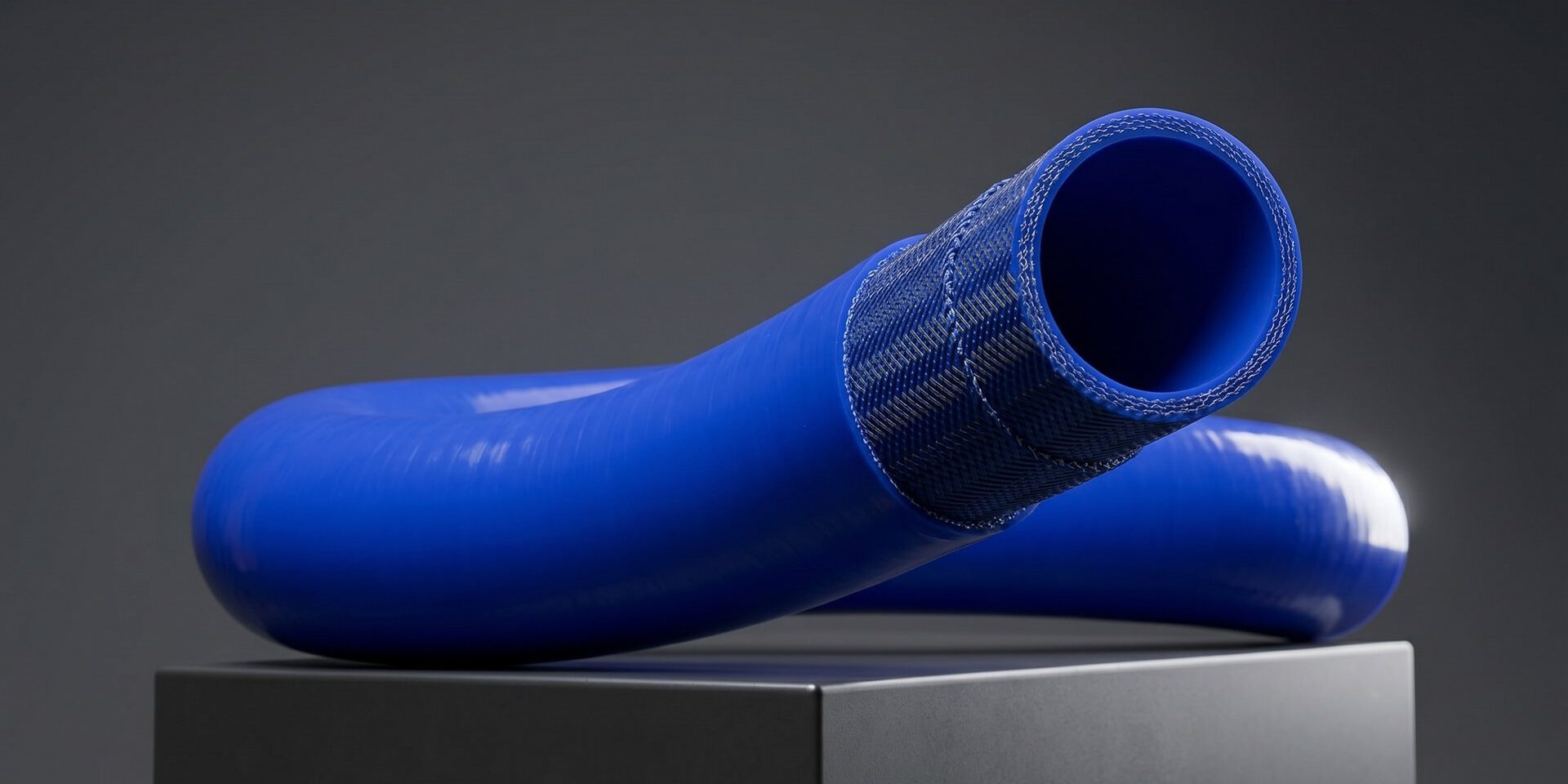
Silicone hose heat resistant: Up to what temperature? 200, 250, 300, 400 °C – the honest answer
Short answer: Standard silicone hoses/tubes withstand continuously –50 °C to +200 °C, and short-term up to approx. +230 °C. High-temperature compounds (HT silicone, usually platinum-cured with modified curing chemistry) reach +250 °C in continuous operation and peaks up to +300 °C for short periods. Advertising claims such as “up to 400 °C” almost always refer to short-term peaks or an external fiberglass braiding, not the pure silicone material. In continuous use above the specified range, the material hardens and loses elongation at break – the service life decreases disproportionately.
“Heat resistant up to 300 °C or 400 °C?” – this question comes almost daily from technical sales. Anyone using silicone hoses/tubes in engines, hot air ovens, paint shops, or baking lines should understand what technical data sheets really say. Here is an honest, standard-based answer.
Continuous operation, short-term, and peak temperature – where the difference lies
The values in a silicone compound data sheet are not a single number, but three different ones:
- Continuous operating temperature – Temperature at which the material maintains its specified mechanical values over a long period (typically several thousand hours).
- Short-term load capacity – Peaks over minutes/hours, for example, when starting up a system or during compressed air purging; the compound is subjected to higher stress but holds up.
- Peak temperature – Seconds to a few minutes; often specified as “up to 300 °C short-term”.
Marketing likes to quote the highest number. However, designers must consider the continuous value in the design temperature.
Where the real limits lie
| Compound Type | Continuous Operation | Short-term Peak | Typical Application |
|---|---|---|---|
| Standard VMQ (Methyl-Vinyl) | –50 … +200 °C | +230 °C | General hoses/tubes, food, pharma |
| High-temperature VMQ (“HT”) | –55 … +250 °C | +300 °C | Hot air, drying ovens, baking lines |
| Phenyl-VMQ (PVMQ) | –90 … +200 °C | +230 °C | Low temperature (aviation, refrigeration) |
| Fluorosilicone (FVMQ) | –55 … +175 °C | +200 °C | Resistance to mineral oils/fuels |
| Silicone with fiberglass braiding | Inside like compound, outside +500 °C+ | short-term +1.000 °C | Fire protection, protection of hoses/cables |
Often, statements like “silicone hose/tube up to 400 °C” are based on the variant with fiberglass braiding (or a silicate jacket) – meaning not the inner silicone material, but an external protective layer. For medium guidance, the pure compound value remains decisive.
Why is silicone so robust against heat?
The bond energy of the Si–O bond in the silicone backbone is approx. 444 kJ/mol, significantly higher than that of the C–C bond in organic elastomers (approx. 350 kJ/mol). This is the material science reason why silicone does not begin to age at 100 °C like many organic rubbers. At the same time, the polymer chain is flexible, so the glass transition temperature is low – hence the unusual spread from –50/–90 °C to 200/250 °C. More background in our article Properties of Silicone.
What happens with continuous heat
- Up to approx. 200 °C: Mechanical properties remain largely stable. Compression set slowly increases.
- 200 – 230 °C: Hardness (Shore A) slowly increases, elongation at break decreases. Service life in continuous operation shortens, no problem short-term.
- 230 – 280 °C: Accelerated curing (“post-cure” effects), material becomes harder and more brittle. Only high-temperature compounds are suitable for continuous use here.
- Above 300 °C: Oxidative and thermal cleavage of organic side groups accelerates. Peak load only, not continuous operation.
In case of fire, silicone forms an electrically insulating silicon dioxide ash layer – this is the basis for applications in fire and functional integrity, for example, for cables in tunnel construction.
Heat is not everything: medium and pressure also count
The temperatures stated in the data sheet apply to “hot air” as the medium. As soon as water vapor, hot oil, or aggressive chemicals are added, the picture changes. Three rules of thumb:
- Hot water vapor acts more aggressively than dry hot air of the same temperature. For sterilization and pharma lines, there are special steam compounds.
- Mineral oil/hot oil: Standard silicone swells significantly below 150 °C. Here, fluorosilicone (FVMQ) is the choice, often combined with a lower maximum temperature.
- Pressure: With increasing temperature, the permissible burst pressure reserve decreases. For hoses/tubes in continuous hot air or hot medium use, safety factors of 3–4 are standard.
How to choose the right heat-resistant silicone hose/tube
- Define design temperature: Continuous operation in °C, peaks in °C, frequency of peaks.
- Clarify medium: Hot air, hot water, steam, oil, food, drinking water, cleaning media (CIP/SIP).
- Pressure range: Underpressure or overpressure, static or pulsating.
- Construction: Pure hose/tube, fabric-reinforced (silicone fabric hose/tube), wrapped hose/tube, molded hose/tube?
- Approvals: BfR XV, FDA 21 CFR 177.2600, USP Class VI, ATEX – depending on the application.
Lindemann manufactures several hose/tube families for precisely these design cases: silicone hot air hoses/tubes up to +260 °C, temperature control hoses/tubes for tool cooling, and molded and wrapped hoses/tubes for complex routing.
“Silicone hose/tube heat resistant up to 300 °C” – is that true?
Yes, but only as a short-term peak for high-temperature compounds. For continuous operation at 300 °C, there is no standard silicone elastomer; here, glass or metal fabrics, silicate elastomers, or other materials (e.g., PTFE hoses/tubes with stainless steel braiding) are more appropriate. For oven outlets, hot air zones in drying, or paint dryers, 250 °C in continuous operation is realistic and safe – with the right HT compound.
And “silicone hose/tube heat resistant up to 400 °C”?
This statement applies almost exclusively to silicone-impregnated fiberglass protective sleeves, which are pulled over other hoses/tubes or cables as a braiding. Here, the glass fabric resists the heat, and the internal silicone serves as a binder and radiation shield. For medium-carrying hoses/tubes, 400 °C continuously is outside the physical limit of silicone elastomers.
FAQ: Silicone hose/tube and heat
How many degrees can a normal silicone hose/tube withstand in continuous operation?
Standard silicone hoses/tubes made of VMQ withstand continuously −50 °C to +200 °C, short-term up to +230 °C. High-temperature compounds extend the continuous range up to +250 °C.
Can silicone withstand 300 °C?
Short-term yes – high-temperature silicone compounds withstand peaks up to +300 °C. Continuous operation at 300 °C is unrealistic for silicone elastomers; above this temperature, thermal-oxidative aging accelerates significantly.
What is the purpose of the fiberglass braiding?
It acts as external heat and fire protection, for example, to shield other components from radiant heat or sparks. It does not change the medium temperature that the inner silicone hose/tube can withstand.
Which silicone hose/tube is suitable for the engine charge air area?
Charge air reaches 130–200 °C in continuous operation and more short-term, depending on the supercharging; at the same time, there is high internal pressure. Here, fabric-reinforced high-temperature silicone hoses/tubes with pressure-absorbing fabric (e.g., multi-layer polyester/aramid) are used – exactly the application field of classic “tuning silicone hoses/tubes”.
What happens to silicone when it gets too hot?
It first post-cures (compression set and hardness increase), becomes more brittle, loses elongation at break, and finally begins to chalk on the surface. In case of fire, a non-conductive SiO₂ ash layer forms, which is why silicone is specified in many fire protection applications.
Is heat-resistant silicone automatically food-safe?
No. Heat resistance is a physical property, food safety is a regulatory one. Food-safe high-temperature compounds exist, but they are separately designated (BfR XV / FDA 21 CFR 177.2600). More on this in our article Food-safe Silicone.
Sources
- Shin-Etsu Silicones: Characteristic Properties of Silicone Rubber Compounds (data sheet overview).
- Wacker Chemie: Technical data sheets ELASTOSIL® R/HT series (high-temperature silicone).
- Bond energies Si–O / C–C: Atkins, Physical Chemistry; Greenwood & Earnshaw, Chemistry of the Elements.
- DIN ISO 1817 (Determination of the effect of liquids) and ISO 188 (Heat aging of elastomers).
- BfR Recommendation XV “Silicones” – bfr.bund.de.