

Elastomers in engineering: materials for seals and hoses
Common elastomers for seals, hoses and moulded parts include silicone (VMQ), fluorosilicone (FVMQ), EPDM, NBR, FKM, natural rubber (NR) and chloroprene (CR). The appropriate material is determined by the continuous operating temperature range, the contact medium including cleaning agents, the permissible compression set and the required approval. Cost is a secondary criterion, as a component failure in the field generally costs more than the premium for the appropriate compound. The following sections assess these materials from a silicone processor’s perspective and explain where most selection and installation errors occur.
Silicone (VMQ) and fluorosilicone (FVMQ)
Silicone elastomers typically cover a continuous operating temperature range of -60 °C to +200 °C. Certain compounds withstand higher peaks for short periods, while phenyl-modified grades (PVMQ) remain flexible at even lower temperatures. Their properties change comparatively little across this range, and ozone and UV radiation have little effect on the material. Typical hardness values range from 20 to 80 Shore A. The limitations are mechanical: tear propagation resistance and abrasion resistance are lower than those of NR or NBR, and gas permeability is high. Silicone is therefore primarily suited to static sealing applications. Our article on silicone rubber as an engineering material explains how crosslinking and fillers control its properties.
In medical and food processing applications, the curing system matters. Platinum-cured compounds leave no peroxide decomposition products and are preferred for pump tubing and pharmaceutical transfer lines. Peroxide-cured silicones are post-cured after vulcanisation to remove volatile constituents and reduce compression set.
Fluorosilicone (FVMQ) has trifluoropropyl groups on its polymer chain, making it significantly more resistant to fuels and mineral oils than VMQ. Its typical operating range is -55 °C to +175 °C. FVMQ has mechanical properties similar to silicone but is considerably more expensive. It is used where fuel contact coincides with low temperatures and FKM becomes too stiff in the cold.
EPDM, NBR, FKM, NR and CR
EPDM typically operates between -40 °C and +130 °C, with peroxide-cured grades reaching approximately +150 °C. EPDM has very good resistance to hot water, steam, ozone and glycol-based brake fluid, but not to mineral oils, greases or fuels. Its moderate cost makes it a standard material for coolant hoses and seals in hot water applications.
NBR, with a typical operating range of -30 °C to +100 °C, is the standard material for mineral oil, hydraulic oil and greases. A higher acrylonitrile content improves oil resistance but reduces low-temperature flexibility. NBR is sensitive to ozone and weathering. FKM typically covers -20 °C to +200 °C, with low-temperature grades extending further down. It resists fuels, oils and many chemicals well, but its weaknesses include ketones, esters, amines and, depending on the grade, hot water and steam. FKM is significantly more expensive than NBR and EPDM.
NR offers the highest rebound resilience and very good tear and abrasion resistance within a typical range of -50 °C to +80 °C, but it is resistant to neither oil nor ozone. It is used in buffers, vibration dampers and diaphragms. CR has a typical range of -40 °C to +100 °C, provides moderate oil resistance and is less flammable than EPDM or NR due to its chlorine content. Typical components include bellows and cable sheaths.
Assessing media resistance under operating conditions
Resistance tables usually refer to room temperature. Swelling and ageing increase with temperature, so a material that is resistant at room temperature may already swell considerably at operating temperature. In practice, seals often fail because of secondary media omitted from the specification: mineral oil-based assembly greases on EPDM seals, silicone grease on silicone seals, or oil mist on profiles designed only for water contact. CIP cleaning with alkalis, acids and sometimes peracetic acid at elevated temperatures adds further exposure. These cleaning processes often have a greater influence on service life than the product itself.
For reliable material selection, the enquiry should specify the medium, concentration, temperature and exposure time. In borderline cases, an immersion test according to ISO 1817 under realistic conditions is more informative than any table; changes in volume, hardness and strength are assessed.
Compression set: comparable only under identical test conditions
Compression set (CS) according to DIN ISO 815-1 indicates the proportion of compressive deformation that is not recovered after the load is removed. A high CS means a loss of sealing force and consequently leakage after temperature cycling. The value depends strongly on test temperature and duration; it is generally significantly higher at high test temperatures than at moderate temperatures.
Purchasers should therefore compare data sheets from different suppliers only at identical temperatures, durations and compression levels, and request CS values at operating temperature where necessary. Post-curing reduces CS in silicone, while peroxide-cured EPDM compounds typically achieve better values than sulphur-cured compounds.
Approvals: BfR, FDA, USP Class VI and EN 45545
Regulation (EC) No. 1935/2004 applies to food contact in the EU. In Germany, the BfR Recommendations provide specific requirements for elastomers: Recommendation XV for silicones and Recommendation XXI for natural and synthetic rubber. These are not laws, but they serve as recognised benchmarks. In the USA, FDA 21 CFR 177.2600 regulates rubber articles intended for repeated use and specifies permitted formulation ingredients and extraction limits. Both forms of compliance documentation relate to a specific compound, including its colour; a custom colour is not automatically covered.
USP Class VI is a test classification under USP Chapter 88 involving in vivo tests for systemic toxicity, intracutaneous reactivity and implantation. It is not an approval of the medical device; biological evaluation according to ISO 10993 remains the responsibility of the medical device manufacturer.
In railway vehicle construction, EN 45545-2 specifies fire protection requirements with hazard levels HL1 to HL3. Requirement sets R22 (interior) and R23 (exterior) are frequently applied to seals and profiles. These require flame-retardant compounds, for example based on silicone or CR, such as those also used for silicone profiles in vehicles.
Matching the material to the component
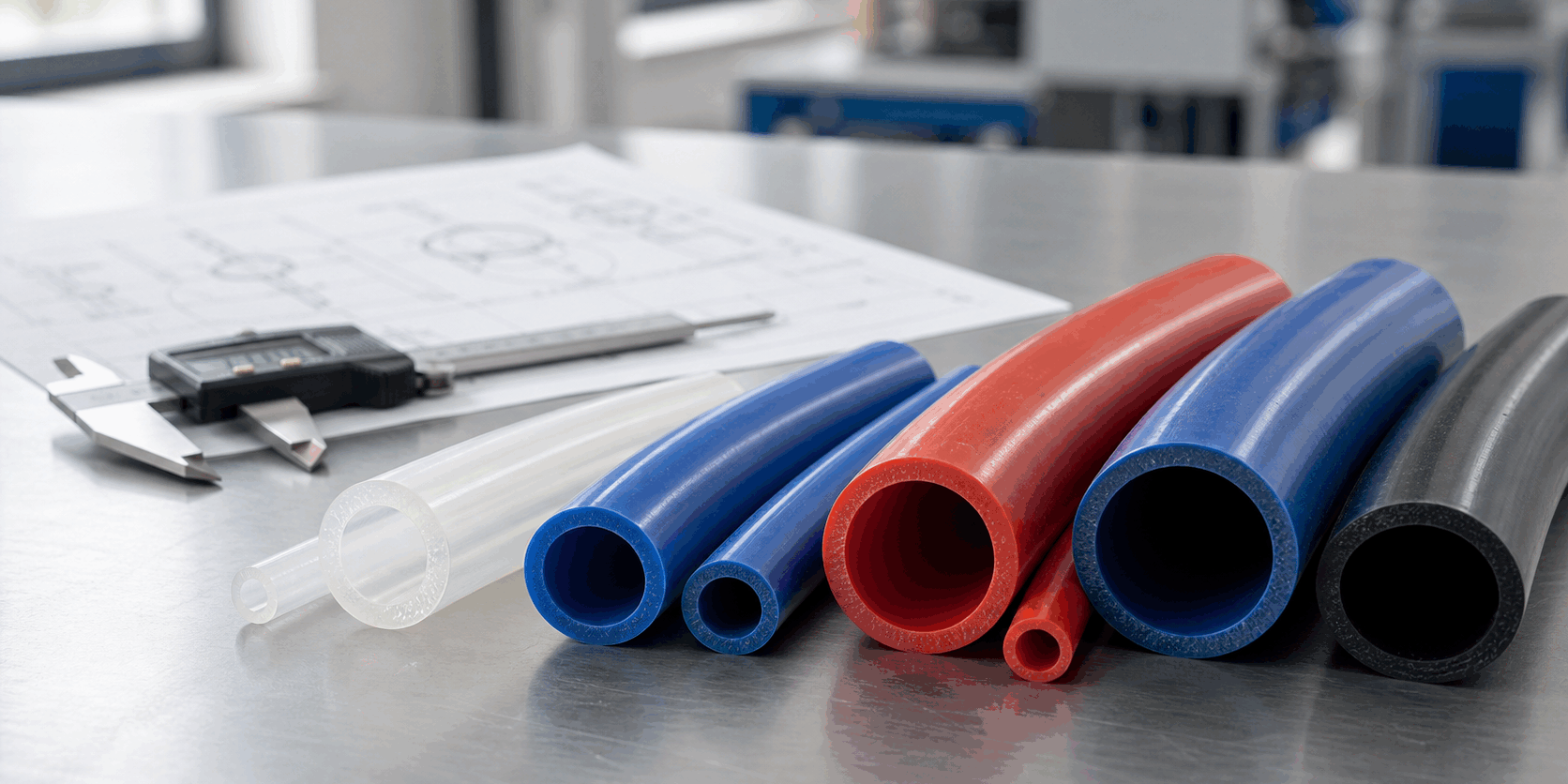
Tubing for food, pharmaceutical and peristaltic pump applications is predominantly made from platinum-cured silicone. Vehicle coolant hoses are usually made from EPDM, while charge air hoses downstream of the turbocharger use fabric-reinforced silicone, with an FKM inner layer where oil mist is present. FKM, FVMQ or NBR are options for fuel lines. For seals, movement is the deciding factor: NBR or FKM for dynamic hydraulic seals, VMQ or FKM for static sealing at high temperatures, and silicone foam for enclosure seals requiring low closing force. Designs and installation are covered in our article on silicone O-rings, flat gaskets and moulded seals. Moulded parts with a damping function are more commonly made from NR or CR.
The most common errors occur during specification. A description such as “silicone 60 Shore A” defines neither the compound nor its approval. A material that is too hard increases the closing force to the point where covers distort. Silicone typically expands more on heating than other elastomers; if the groove is too small, the seal is squeezed out. The groove must therefore provide sufficient free space for the increase in volume. Samples are also often tested only at room temperature, although failure occurs only after temperature cycling. A complete enquiry specifies continuous and peak temperatures, all media including cleaning agents and assembly aids, the type of movement, pressure, approvals and colour.
Frequently asked questions
What is the difference between raw rubber and an elastomer?
Raw rubber is the uncrosslinked polymer. Only crosslinking during vulcanisation produces an elastomer that deforms under load, then returns to its original shape and does not melt when heated. Thermoplastic elastomers (TPE), by contrast, can be melted and generally do not achieve the temperature resistance of silicone or FKM.
Which elastomer is suitable for hot water and steam?
Peroxide-cured EPDM is the usual material for hot water and saturated steam. Depending on the compound, silicone is suitable for hot water and repeated steam sterilisation, but it ages faster under continuous exposure to saturated steam. Standard FKM has only limited resistance to high-temperature steam, so special grades are required.
Is silicone resistant to oil?
That depends on the oil and the compound. Standard VMQ swells noticeably in many mineral oils and fuels, losing strength in the process. Silicone may be sufficient for occasional splash contact, while FVMQ or FKM are the usual choices for continuous contact. An immersion test using the actual oil provides clarity.
Is FDA compliance sufficient for food applications in the EU?
Not automatically. Regulation (EC) No. 1935/2004 applies in the EU. In Germany, the BfR Recommendations serve as assessment benchmarks, with Recommendation XV applying to silicone. Many equipment manufacturers therefore require compliance with both BfR XV and FDA 21 CFR 177.2600, in each case for the specific compound and the colour supplied.