


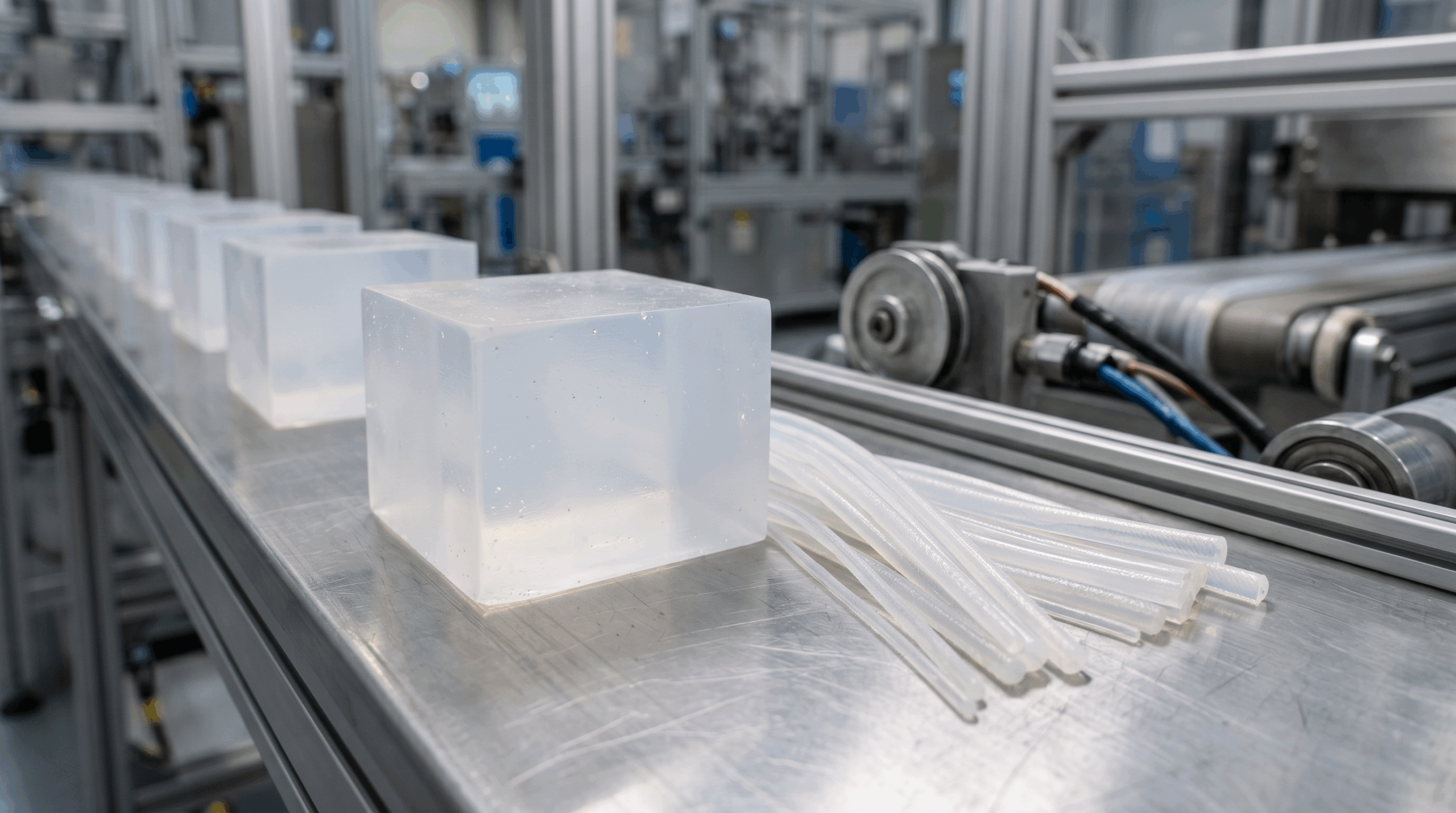
Silicone rubber is a cross-linkable polysiloxane elastomer that remains permanently elastic at temperatures from -60 °C to +250 °C. Depending on the cross-linking system, a distinction is made between HTV (solid silicone), LSR (liquid silicone) and RTV (room-temperature vulcanizing). Lindemann processes all three types using extrusion, injection molding and calendering to manufacture hoses, profiles and molded parts.
What is silicone rubber?
Silicone rubber (chemically correct: polysiloxane elastomer) is a synthetic material consisting of an inorganic Si-O-Si backbone with organic side groups, typically methyl (-CH₃) or vinyl (-CH=CH₂). The term “rubber” refers to the rubber-like, elastic behavior after cross-linking – not to a chemical relationship with natural rubber.
Cross-linking is achieved using peroxides, platinum complexes or tin catalysts. Only after cross-linking does silicone rubber acquire its characteristic properties: high temperature resistance, elasticity well below the freezing point, UV and ozone resistance, and chemical inertness toward most acids and alkalis.
Overview of silicone rubber types
Lindemann processes three main classes of silicone rubber, which differ in supply form, processing and properties:
| Type | Supply form | Processing | Application |
|---|---|---|---|
| HTV (High Temperature Vulcanizing) | Solid silicone (kneadable compound) | Extrusion, compression molding, calendering at 150-200 °C | Hoses, profiles, seals in series production |
| LSR (Liquid Silicone Rubber) | 2-component liquid | Injection molding at 180 °C in the heated tool | Micro-molded parts, medical components, complex geometries |
| RTV-1 | 1-component from cartridge | Cross-linking with atmospheric humidity at room temperature | Sealants, bonding, repair |
| RTV-2 | 2-component liquid | Cross-linking after mixing at room temperature | Mold making, prototyping, electronic potting |
Properties of silicone rubber
The most important physical and chemical properties of silicone rubber make it one of the most versatile elastomers in industrial use:
- Temperature range: continuous -60 °C to +250 °C, short-term up to +350 °C
- Hardness: Shore A 10 to Shore A 90, depending on formulation
- Tensile strength: 5 to 12 N/mm² for standard VMQ, up to 15 N/mm² for reinforced compounds
- Elongation at break: 200 to 800 %
- Compression set: typically 10-25 % after 22 h at 175 °C
- Electrical insulation: dielectric strength > 20 kV/mm
- Weather resistance: UV-, ozone- and aging-stable for decades
- Food and medical approvals: compliant with BfR XV, FDA 21 CFR 177.2600, USP Class VI
Processing on an industrial scale
Lindemann manufactures silicone rubber products using three main processes: extrusion for continuous hoses and profiles (wall thicknesses from 0.5 to 25 mm, diameters up to 200 mm), injection molding for complex LSR molded parts with tolerances from ±0.05 mm, and compounding for customer-specific material blends with defined properties such as electrical conductivity, flame retardancy or enhanced temperature stability.
Cross-linking takes place in continuous hot-air channels (HAV process) at 250-350 °C or in the tool at 180 °C (LSR injection molding). This is followed by a 4-hour post-curing process at 200 °C for complete curing and removal of volatile components.
Application areas for silicone rubber
Thanks to its material versatility, silicone rubber is used in virtually every industrial sector:
- Food industry: hoses for beverage filling, brewery connections, seals for CIP/SIP systems
- Medical technology: drainage and infusion tubing, membranes, implant components
- Pharmaceutical industry: sterile hoses, peristaltic pump tubing, seals for cleanrooms
- Automotive: engine compartment seals, turbocharger hoses, coolant connections
- Electrical engineering: cable insulation, connector seals, LED diffusers
- Construction industry: fire-protection seals, glazing, sanitary joints
Frequently asked questions
Silicone rubber is the technically precise term for vulcanized silicone elastomers. In everyday language, the word “silicone” is often used on its own – chemically, both terms are identical. Uncross-linked silicone would be a viscous polysiloxane mass; only cross-linking produces the elastic end product.
Silicone rubber is long-lasting (service life of 20+ years), inert and releases no harmful substances into the environment. Its raw material, silicon, is the second most abundant element on Earth after oxygen. During disposal, silicone breaks down into silicon dioxide (sand), CO₂ and water. Production is, however, energy-intensive – silicone recycling concepts are currently being developed.
Silicone rubber is typically manufactured in Shore A 30 to Shore A 80. For very soft applications, Shore A 10-20 is possible; for particularly hard technical parts, up to Shore A 90. Lindemann produces all hardness grades within this range to customer specification.
With proper design, silicone rubber achieves a service life of 20 to 30 years. Unlike classical rubber materials, no UV or ozone aging occurs. Mechanical service life depends on temperature, load and chemical environment – in standard applications, 100,000 to 1,000,000 load cycles are possible.
Standard silicone rubber costs EUR 8-15/kg, high-temperature-stable compounds EUR 15-25/kg, medical LSR grades EUR 25-60/kg. Specialty compounds (electrically conductive, flame-retardant) reach up to EUR 100/kg. Lindemann provides unit prices on request based on material, geometry and quantity.
Specially certified silicone rubber grades meet the requirements for direct food contact in accordance with BfR XV, FDA 21 CFR 177.2600 and Regulation (EU) 10/2011. Lindemann supplies food-grade hoses and seals with a complete declaration of conformity and migration testing.
Consultation and inquiry
Lindemann Silikon GmbH has been manufacturing silicone rubber products for demanding industrial applications for 30 years. We advise you on material selection and supply data sheets and declarations of conformity. Request a non-binding quote now.