


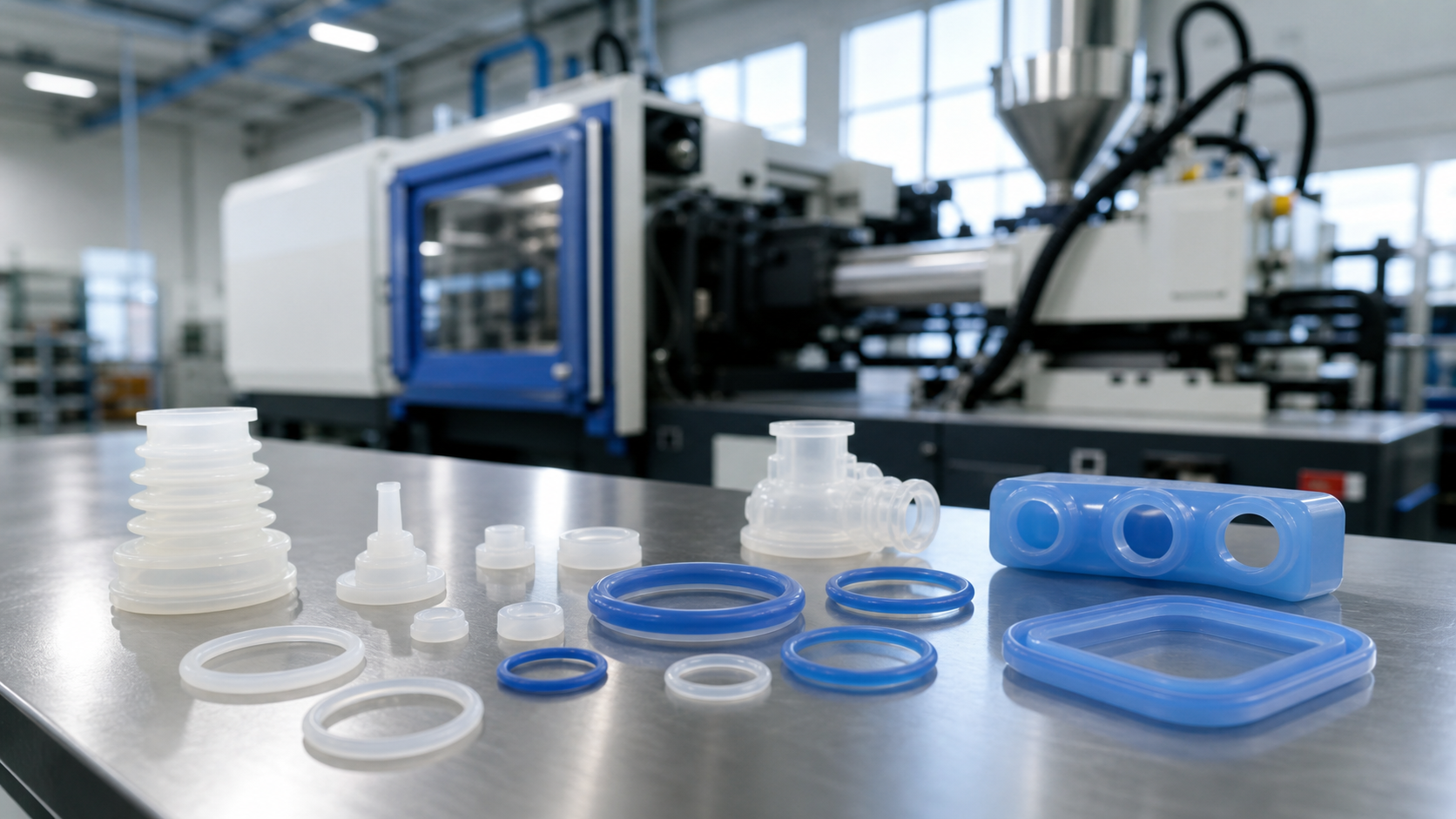
Silicone injection molding, also known as LIM (Liquid Injection Molding), is the most economical process for the series production of precise silicone molded parts. In the 2-component process, liquid silicone (LSR) is injected into heated moulds and cures at 180 °C within 30 to 90 seconds. Lindemann uses the LIM process to manufacture medical components, food-contact parts, micro molded parts and multi-component composite parts.
How does silicone injection molding work?
In silicone injection molding, two liquid silicone components (A and B) are metered in an exact 1:1 ratio, homogenized in a static mixing unit and injected through a cold runner into the heated mould. At a mould temperature of 160–200 °C, the silicone cures completely within 30 to 90 seconds.
The low viscosity of LSR (typically 100,000 to 1,000,000 mPas) makes it possible to fill the finest structures — compared with thermoplastic injection molding, wall thicknesses below 0.2 mm and micro details below 0.1 mm can be reliably reproduced.
Advantages of the LIM process
Silicone injection molding offers substantial advantages over conventional extrusion and compression molding processes:
- High repeatability: tolerances from ±0.05 mm in series production
- Short cycle times: 30–90 seconds per part
- No waste: cold runner gating systems are scrap-free
- Cleanroom-capable: automated production in ISO Class 7/8 possible
- Multi-component bonding: direct overmolding onto thermoplastic, metal or a second silicone hardness
- Scalable: economical from 5,000 parts per year up to volumes in the millions
Tool design for LIM
Silicone injection molding tools differ fundamentally from thermoplastic tools. Key design features:
- Cold runner system (hot mould, cold nozzle): prevents premature curing in the gate
- Venting: silicone is a light polymer, so air entrapments must be removed in a controlled way — usually via parting line surfaces or defined gap venting
- Material: typically tool steel 1.2343 ESU with hard chrome plating due to the high mould temperatures
- Demolding aids: ejector pins or vacuum lift-off; release agents are usually not necessary in silicone injection molding
Materials for silicone injection molding
The standard material is LSR (Liquid Silicone Rubber) processed in 2-component form. Depending on the application, different grades are used:
| Material | Hardness | Property | Application |
|---|---|---|---|
| LSR Standard | Shore A 30–70 | transparent, highly elastic | baby products, drinking cups, consumer goods |
| LSR Medical (USP VI) | Shore A 30–80 | biocompatible, sterilizable | catheter tips, membranes, implants |
| LSR Food-grade | Shore A 30–70 | BfR XV, FDA-compliant | baking moulds, baking seals |
| LSR conductive | Shore A 50–70 | electrical conductivity | EMC seals, contacting membranes |
| LSR high-temperature | Shore A 50–80 | up to +250 °C continuous | engine compartment parts, industrial furnace seals |
Applications of silicone injection molded parts
Silicone injection molding is the process of choice for demanding applications with high volumes:
- Medical technology: ventilation masks, drainage connectors, pump valves, insulin pen components
- Food and baby products: suction valves, breast pump attachments, food-grade closure mechanisms
- Automotive: sensor seals, connector housings, membranes for pressure regulators
- Electronics: keypad mats, protective caps, vibration-damping components
- Consumer goods: kitchen utensils, baking moulds, ergonomic grip materials
LIM at Lindemann
Lindemann operates several LIM machines with clamping forces from 50 to 250 tonnes and shot weights from 0.5 to 500 grams. Production takes place in climate-controlled halls with a cleanroom option (ISO 8). For small series and prototypes we offer injection molding sampling with lead times from 4 weeks after tool release.
Frequently asked questions
LIM stands for Liquid Injection Molding and refers to the injection molding process for liquid silicone (LSR). Unlike thermoplastic injection molding, LIM works with heated moulds (160–200 °C) and cold nozzles. The process delivers high repeatability and short cycle times.
With thermoplastics, the screw is hot and the tool is cold. With silicone it is the opposite: the screw and nozzles are cooled (15–20 °C) and the tool is heated (180 °C). In addition, silicone injection molding works with 2 components (A + B) that are combined in the mixer.
Economical from about 5,000 to 10,000 parts per year. At lower volumes, compression moulds (HTV) or cast moulds (RTV-2) are cheaper because the tool costs are lower. From 50,000 parts per year, silicone injection molding is unrivaled in cost efficiency.
Simple tools (single-cavity, standard material) range from €15,000–30,000. More complex multi-cavity tools with 4–16 cavities and a multi-component option reach €60,000–200,000. Tool costs typically pay back from 50,000–200,000 parts.
Yes, in 2K-Verbundspritzguss (2-component composite injection molding). The thermoplastic (PBT, PA, PEEK) is injected first and the LSR is then overmolded directly in the same tool. Chemical adhesion is created by reactive groups in the LSR or by a pre-injected adhesion promoter layer. Lindemann regularly produces 2-component composite parts for the automotive and medical industries.
Tolerances from ±0.05 mm are achievable in the standard process. Micro molded parts can be produced to ±0.02 mm. Larger parts (above 50 mm edge length) reach ±0.1 to ±0.2 mm. Shrinkage of LSR is typically 2.5–3.5 %, which must be taken into account during tool design.
Consultation and inquiry
Planning a silicone injection molding project and need advice on tool design, material selection or cost efficiency? Talk to our LIM experts.