


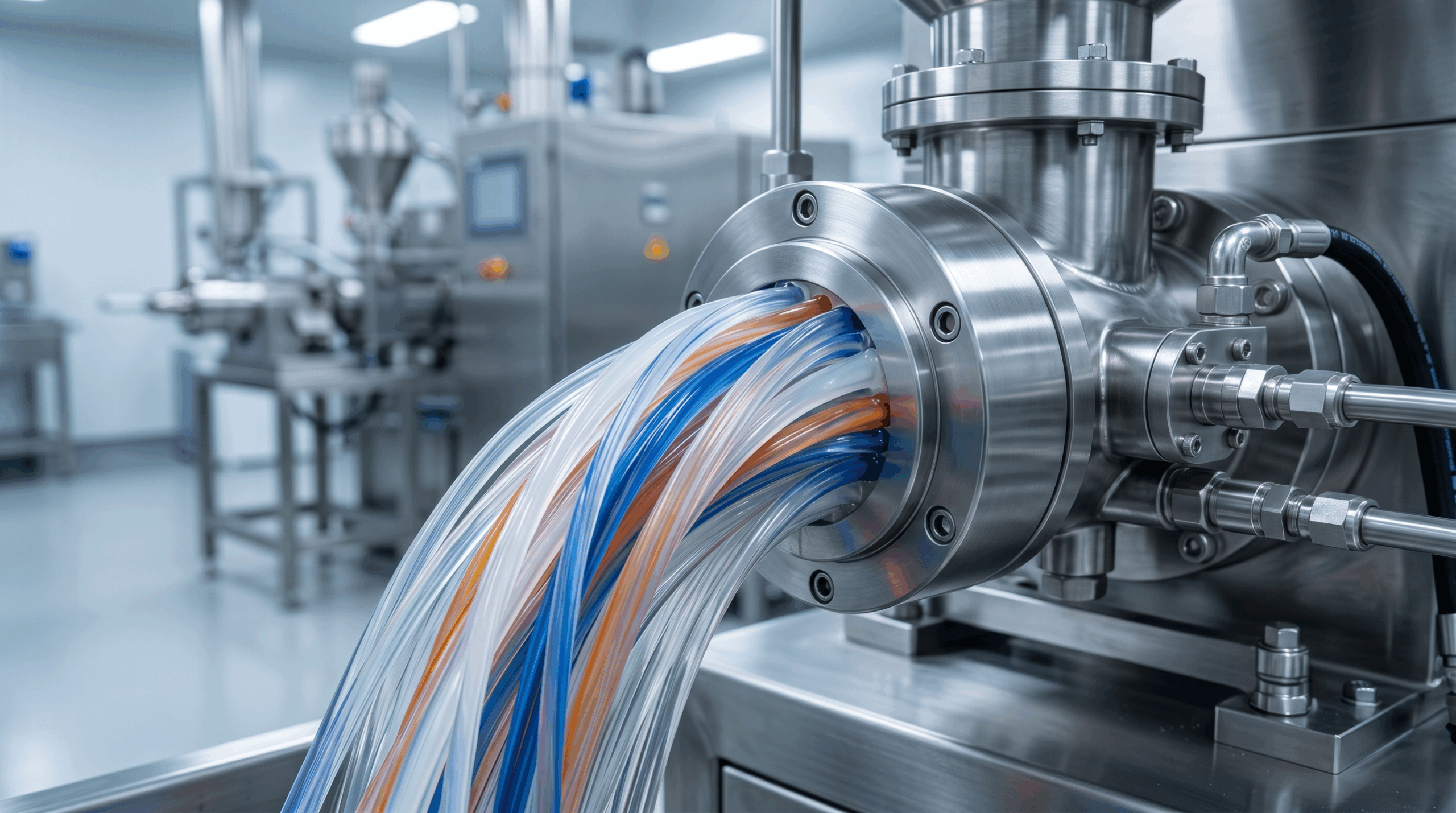
Standard silicone does not meet every requirement. For demanding applications, Lindemann develops custom silicone compounds with precisely engineered properties: electrical conductivity, flame retardancy, increased temperature resistance, food-grade color settings or specific mechanical values. Compounding takes place in our own plant in batches starting at 25 kg.
What is a silicone compound?
A silicone compound is a tailor-made mixture of base silicone polymer, reinforcing fillers, pigments, crosslinking system and functional additives. While standard silicones (HTV or LSR) consist of standardized formulations, a compound is specifically tuned to an application — with defined hardness, color, temperature resistance, conductivity or flame retardancy.
Compounding takes place in internal mixers (Banbury type) or on roll mills by step-by-step incorporation of the components. The compound is then tested and released for further processing (extrusion, injection molding, compression molding).
Properties that can be adjusted in the compound
The most important material properties can be specifically adjusted through the formulation:
| Property | Standard value | Compound adjustment range |
|---|---|---|
| Shore A hardness | 60 | 10 to 90 |
| Continuous temperature | +200 °C | +250 °C to +300 °C (special compound) |
| Tensile strength | 8 N/mm² | 5 to 15 N/mm² |
| Elongation at break | 400 % | 100 to 1,000 % |
| Compression set | 20 % (24h/175°C) | 5 to 30 % |
| Electrical conductivity | insulator | conductive (10⁰ Ω·cm) to insulating |
| Flame retardancy | self-extinguishing | UL94 V-0 with halogen-free option |
| Color | transparent / white | all RAL colors, fluorescent, metallic |
Types of custom compounds
Lindemann regularly produces the following compound types for industrial applications:
Conductive silicone compounds
The addition of carbon black, silver or nickel particles creates electrically conductive silicones with resistivities from 10⁰ to 10⁶ Ω·cm. Applications: EMI shielding, contact elements, ESD dissipation, heated hoses.
Flame-retardant compounds (V-0)
With aluminium hydroxide (ATH) or phosphorus-based flame retardants, silicone compounds achieve the highest fire protection classes per UL94 V-0 and EN 45545 (rail industry). Applications: fire protection seals, rail vehicles, elevator components.
High-temperature compounds (+300 °C)
Silicones stabilized with cerium compounds and iron oxides withstand up to +300 °C continuously and up to +380 °C short-term. Applications: hot air ducts, industrial furnace doors, exhaust hangers.
Thermally conductive compounds
With boron nitride or aluminium oxide, silicones become electrically insulating yet thermally conductive (up to 5 W/(m·K)). Applications: heat dissipation pads for electronics, battery cooling in electric vehicles.
Food and pharma compounds
High-purity platinum-cured compounds for food and pharma contact per BfR XV, FDA 21 CFR 177.2600 and USP Class VI. Applications: pharma hoses, brewery seals, sterile membranes.
From specification document to compound: The development process
A custom compound is created in a structured process from requirements definition to series release:
- 1. Requirements analysis: customer defines the specification document (temperature, media, hardness, standards)
- 2. Material development: formulation draft based on the Lindemann compound database
- 3. Lab sample: initial sample at 5–10 kg scale, tested against the specification document
- 4. Pilot batch: 50–200 kg, released in the pilot application at the customer
- 5. Series release: delivery from 25 kg per batch, all data documented
- 6. Audit and re-validation: annual re-validation of compound quality
Frequently asked questions
Standard compounds range from €12–20/kg. Specialty compounds (conductive, flame-retardant, high-temperature stable) range from €20–60/kg. High-purity medical compounds reach €60–120/kg. The development cost for a new compound is a one-time €3,000–15,000 depending on complexity.
A simple color adjustment takes 2–4 weeks. A new formulation (e.g. conductive or flame-retardant) typically takes 8–12 weeks from specification document to pilot batch. Complex medical compounds with approval procedures can take 6–12 months.
Compound development becomes economically worthwhile from an annual quantity of about 500 kg. Below that, we recommend using a suitable standard compound from our portfolio and adapting the geometry or the process.
Yes, silicone can be adjusted to virtually any color with inorganic pigments or food-grade masterbatches. All RAL colors are available as standard, and on request also fluorescent, metallic or color-changing effects.
The formulation of a compound belongs to the customer and is subject to full confidentiality. On request, Lindemann offers exclusive compound agreements with non-disclosure clauses. Patenting the formulation is possible, but is usually maintained as a trade secret.
Depending on requirements, approvals per BfR XV, FDA 21 CFR 177.2600, USP Class VI, ISO 10993, UL94 V-0, EN 45545 (rail), MIL-Spec and customer-specific factory standards are possible. Lindemann issues the complete declarations of conformity and material data sheets.
Consultation and inquiry
Do you need a silicone with special properties that does not yet exist? Lindemann develops the right compound for you — from the specification document to series release. Schedule a development consultation now.