


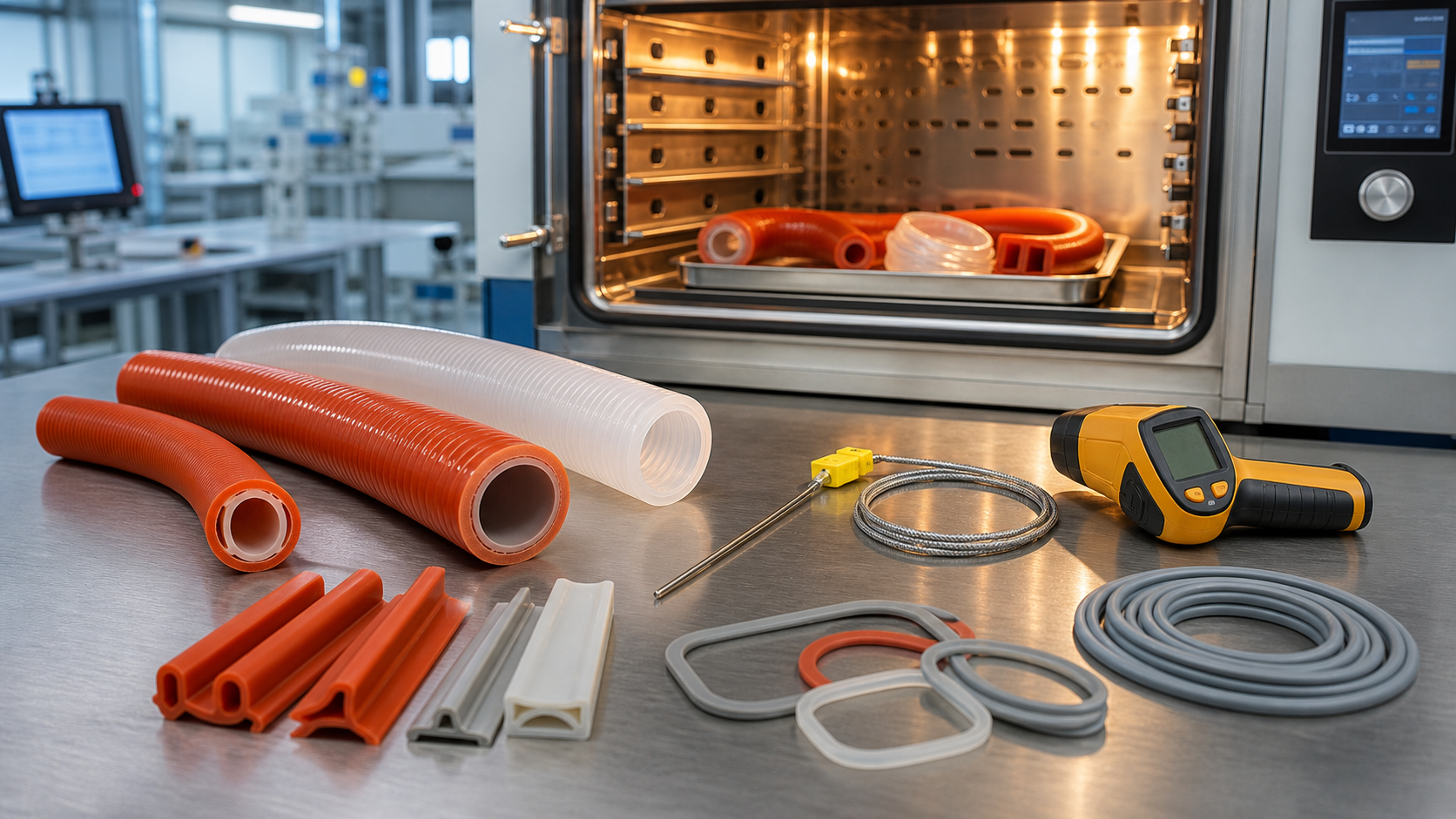
Silicone is one of the most temperature-stable elastomers available. Standard silicone (VMQ) is continuously resistant from -50 °C to +200 °C and withstands up to +300 °C for short periods. High-temperature silicone (HTV) reaches +250 °C continuously and +350 °C short-term, while phenyl silicone (PVMQ) extends down to -100 °C in the low-temperature range. Silicone therefore covers a temperature window that no other elastomer comes close to matching.
Temperature ranges of the main silicone grades
The overview below shows continuous and peak temperatures for the most important silicone grades. These values apply to correctly dimensioned components without additional extreme chemical loads.
| Silicone grade | Continuous | Short-term | Min. temperature | Typical application |
|---|---|---|---|---|
| VMQ (standard silicone) | +200 °C | +300 °C / 15 min | -50 °C | Hoses, profiles, seals |
| HTV silicone (high-temperature) | +250 °C | +350 °C / 30 min | -60 °C | Engine seals, industrial ovens |
| PVMQ (phenyl silicone) | +200 °C | +250 °C | -100 °C | Aerospace, cryogenics |
| FVMQ (fluorosilicone) | +200 °C | +250 °C | -55 °C | Fuel and oil contact |
| LSR (Liquid Silicone Rubber) | +200 °C | +250 °C | -50 °C | Medical, food contact, micro parts |
| Specialty silicone (HCR + heat stabilizer) | +300 °C | +380 °C / short | -50 °C | Fire protection, hot air ducts |
What does temperature resistance mean for silicone?
Temperature resistance describes the range in which a silicone elastomer retains its mechanical and chemical properties. Two values matter: the continuous service temperature (sustained load over months or years) and the peak temperature (short-term load over minutes to hours). While thermoplastics such as PE or PP lose their shape at just 80 °C, silicone keeps its elasticity and sealing function up to +200 °C and beyond.
This high temperature resistance is based on the Si-O-Si bond in the polysiloxane backbone. At 450 kJ/mol, this bond is significantly stronger than the C-C bond of organic polymers (350 kJ/mol). That is why silicone is thermally far more stable than conventional plastics and rubber materials.
Short-term vs. continuous temperature load
The distinction between continuous and short-term temperature is critical for component design. A silicone hose in a coffee machine sees 95 °C as a continuous load – no problem for VMQ. An oven door seal experiences 220 °C in continuous operation – HTV is required here.
Continuous temperature defines the range in which silicone retains its key properties (tensile strength, compression set, elasticity) over 1,000 to 10,000 hours. Above this limit, gradual oxidative embrittlement sets in.
Short-term temperature is the upper limit for temporary loads – such as steam sterilization, hot wash cycles or startup peaks in process equipment. Here the load duration is limited to minutes or a few hours before the material is permanently damaged.
Silicone grades and their temperature ranges
Lindemann processes different silicone grades depending on the application. The choice directly affects the maximum temperature and therefore the service life of the component in use.
VMQ – standard silicone for most applications
VMQ (vinyl methyl silicone) is the most economical silicone grade. With a continuous temperature range of -50 °C to +200 °C, VMQ covers roughly 80% of all industrial silicone applications: sanitary hoses, food processing machinery, pharmaceutical hoses, standard profiles. Lindemann manufactures VMQ products in Shore hardnesses from A 30 to A 80.
HTV silicone – for continuous temperatures above 200 °C
HTV (High Temperature Vulcanizing) in this context does not refer to the processing method but to a specially heat-stabilized compound. The addition of iron oxide pigments or cerium compounds significantly increases oxidation stability – HTV silicone withstands +250 °C continuously. Application areas: engine compartment seals, oven door seals, industrial ovens, hot air hoses.
PVMQ – phenyl silicone for low temperatures
PVMQ contains additional phenyl groups on the polysiloxane backbone. These shift the glass transition point from -120 °C (standard VMQ) to around -135 °C. As a result, PVMQ remains elastic in practical service down to -100 °C. Main applications: aerospace, low-temperature logistics, cryogenics.
FVMQ – fluorosilicone for oil and fuel contact
FVMQ combines the temperature stability of silicone with the chemical resistance of fluoropolymers. From -55 °C to +200 °C, FVMQ resists mineral oils, gasoline, diesel and many solvents – an envelope where standard VMQ fails. Use cases: automotive fuel lines, hydraulic seals, pump diaphragms in chemical processing.
LSR – liquid silicone rubber for complex injection-molded parts
LSR (Liquid Silicone Rubber) is processed by two-component injection molding. Temperature range: -50 °C to +200 °C, and up to +250 °C short-term with special heat stabilizers. LSR enables the highest dimensional accuracy and short cycle times – ideal for medical micro parts, baby products, food-contact molded parts and multi-component composites (LSR on thermoplastic).
Silicone compared with other elastomers
In a direct comparison, it becomes clear why silicone is unmatched in high-temperature applications. While EPDM and NBR are often the first choice on cost grounds, both materials fail at continuous temperatures above 150 °C.
What happens when temperature limits are exceeded?
Silicone does not melt. It is a crosslinked elastomer and behaves fundamentally differently from thermoplastics. When the continuous temperature is exceeded, slow oxidative embrittlement sets in first – the material becomes harder and tensile strength decreases. This becomes visible after weeks to months.
Above 350 °C, thermal decomposition of the Si-O bonds begins. The end products are silicon dioxide (SiO₂), carbon dioxide and water – all non-toxic. In a fire, silicone leaves behind an insulating SiO₂ layer that protects the material beneath. For this reason, silicone is used in fire protection applications and in cable insulation for safety-critical systems.
Applications of heat-resistant silicone products
Heat-resistant silicone is needed wherever other elastomers fail thermally or chemically. Typical industrial applications include:
- Ovens and hot air ovens – door seals, fan profiles, sight glass seals
- Pharma and food – hot-fill hoses, CIP/SIP-resistant seals, sterilization hoses
- Automotive – engine compartment seals, turbocharger hoses, exhaust hangers
- Industrial ovens and drying systems – hot air hoses, door seals
- Fire protection – fire-resistant cable feedthroughs, fire damper seals
- Rail industry – fire-resistant profiles to EN 45545
- Semiconductor industry – cleanroom seals for high-temperature process chambers
What to consider when selecting the material
The right material choice comes down to four factors:
- Maximum continuous temperature – the temperature that actually applies in normal operation, not the theoretical peak value
- Load duration – intermittent or continuous load. Under cyclic loading, temperature peaks are less critical
- Accompanying media – oil, acid, steam, food. These change the allowable maximum temperature and may require a switch to FVMQ or specialty compounds
- Economics – HTV is around 30-50% more expensive than VMQ. For applications just above 200 °C, the additional investment is usually justified because service life increases by a factor of 3 to 5
The table below contrasts the continuous temperature resistance of the main elastomers – as a quick orientation aid for material selection.
| Elastomer | Continuous temperature | Comments |
|---|---|---|
| Natural rubber (NR) | max. +80 °C | unsuitable for high temperature |
| NBR (nitrile rubber) | max. +100 °C | good with oil, weak under heat |
| EPDM | max. +150 °C | good with hot water and steam up to 150 °C |
| VMQ silicone | +200 °C | standard for high-temperature seals |
| FKM (Viton) | +230 °C | oil-resistant, more expensive |
| HTV silicone | +250 °C | highest continuous temperature among standard elastomers |
| FFKM (perfluoroelastomer) | +260 °C | extreme chemical resistance, high cost |
Standard silicone (VMQ) is continuously heat-resistant from -50 °C to +200 °C, and up to +300 °C short-term. High-temperature silicone (HTV) reaches +250 °C continuously and +350 °C short-term. This makes silicone one of the most temperature-stable elastomers available, clearly outperforming EPDM (150 °C), NBR (100 °C) and natural rubber (80 °C).
Yes, silicone is among the most heat-resistant elastomers available. Continuous service temperature is between +200 and +250 °C, with short-term peaks up to +350 °C. The high stability is based on the Si-O-Si bond in the polysiloxane backbone, which at 450 kJ/mol is significantly stronger than the C-C bond of organic polymers. For applications above 250 °C, specialty HTV compounds are used.
No, silicone does not melt. It is a crosslinked elastomer (polysiloxane network) and behaves fundamentally differently from thermoplastic materials. At very high temperatures (above approximately 350 °C), silicone decomposes thermally to silicon dioxide (SiO₂), carbon dioxide and water – with no liquid phase. In a fire, a protective SiO₂ layer forms.
Thermal decomposition of silicone begins between 350 and 400 °C. First, the methyl side groups on the polysiloxane break off, then the Si-O-Si backbone breaks down with the formation of silicon dioxide. The process is non-toxic and only minimally exothermic. Specialty compounds with cerium or iron stabilizers shift decomposition upward by 30 to 50 °C.
No, no standard silicone withstands 500 °C continuously. Even highly stabilized HTV compounds reach a maximum of 380 °C short-term. For temperatures above 400 °C, other materials are used: graphite flat gaskets, expanded PTFE or glass fiber composites. In a brief fire (seconds to minutes), silicone thermally endures significantly higher temperatures short-term thanks to SiO₂ layer formation.
Highly stabilized HTV compounds with iron oxide or cerium heat stabilizers achieve the highest continuous temperature among standard silicones: +250 to +300 °C continuously, with short-term peaks up to +380 °C. Lindemann manufactures these specialty compounds for extreme applications such as industrial oven doors, hot air ducts and fire protection elements. Where required, individual designs are developed to customer specifications.
Standard silicone remains fully elastic down to -50 °C. Phenyl silicone (PVMQ) reaches -100 °C, and some specialty compounds go down to -115 °C. This makes silicone the only elastomer that covers the entire range from cryogenics (-100 °C) to high-temperature ovens (+250 °C). Note: the glass transition temperature of VMQ is around -120 °C; below this point the material becomes brittle.
Ranking by continuous temperature resistance: natural rubber +80 °C, NBR +100 °C, EPDM +150 °C, VMQ silicone +200 °C, FKM (Viton) +230 °C, HTV silicone +250 °C, FFKM (perfluoroelastomer) +260 °C. HTV silicone and FFKM are essentially tied at the top, but FFKM is roughly ten times more expensive and is mainly used where extreme chemical resistance is required.
Heat-resistant silicone direct from the manufacturer
Lindemann Silikon GmbH has been manufacturing heat-resistant silicone hoses, profiles, seals and molded parts for industry, medical, food and pharma for more than 30 years. We advise on the right material selection and supply material data sheets, declarations of conformity and load certifications on request. Request a non-binding quote now.