


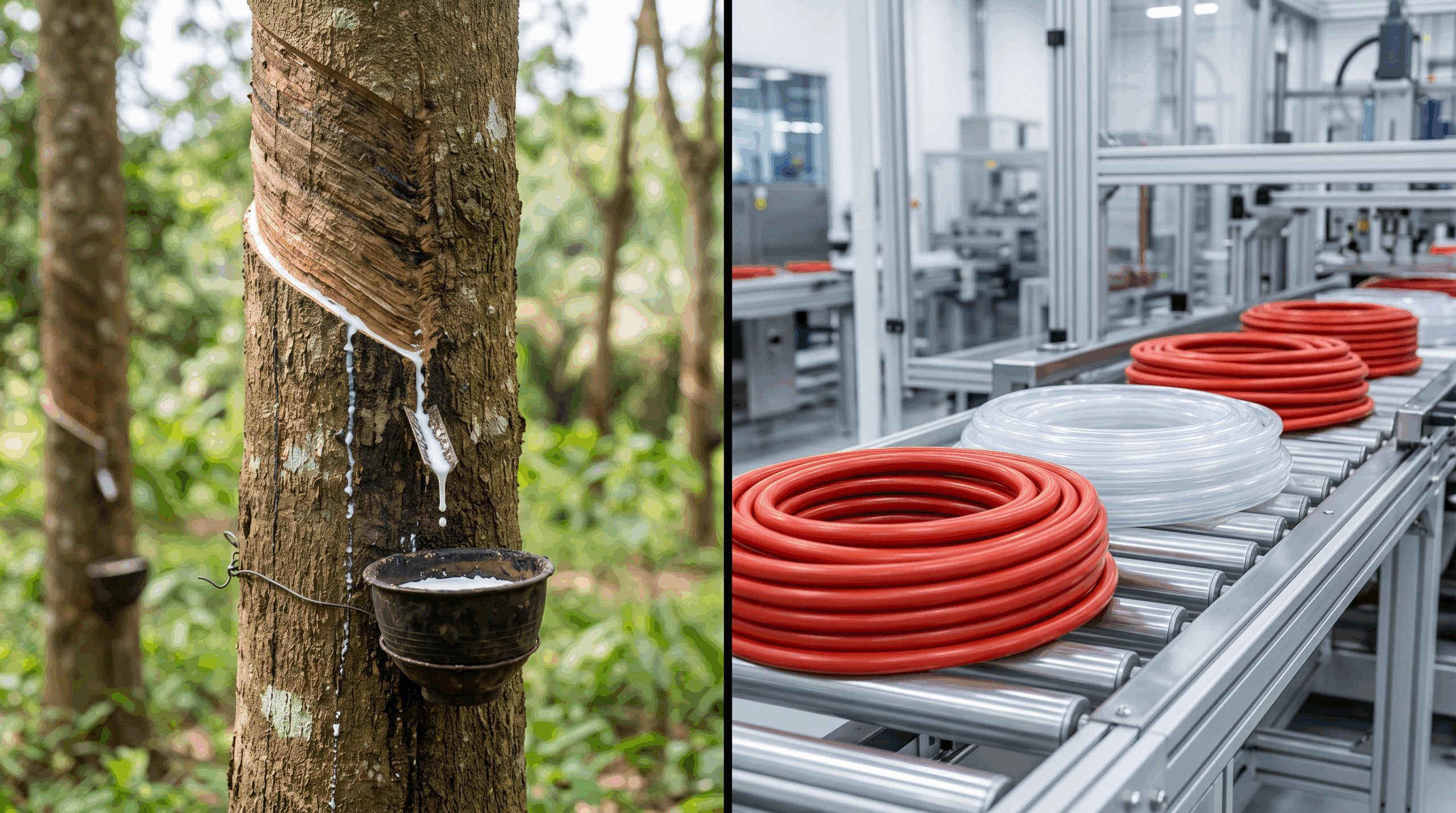
Natural rubber and silicone are both elastic materials, yet they are fundamentally different in their chemistry and properties. Natural rubber is harvested from the sap of the rubber tree (Hevea brasiliensis) and is a purely organic polymer. Silicone is a fully synthetic polysiloxane based on quartz sand. Silicone is superior in temperature resistance, UV stability and chemical inertness, while natural rubber leads in tensile strength and price.
Natural Rubber: Origin and Properties
Natural rubber (NR, chemically cis-1,4-polyisoprene) is extracted from the latex sap of the rubber tree. After coagulation and vulcanization, the result is a highly elastic material with outstanding tensile strength (20-30 N/mm²) and excellent abrasion resistance. For more than 150 years, natural rubber has been the reference material for tires, conveyor belts and mechanically heavy-duty rubber parts.
The weaknesses of natural rubber: a maximum continuous service temperature of 80 °C, poor UV and ozone resistance, and swelling in oils and fuels. This makes natural rubber unsuitable for many modern industrial applications.
Silicone: Origin and Properties
Silicone rubber (VMQ, vinyl methyl silicone) is produced synthetically from quartz sand. The Müller-Rochow process generates methylchlorosilanes, which are then polymerized into polysiloxanes and cross-linked with peroxides or platinum catalysts. The Si-O-Si backbone, with a bond energy of 450 kJ/mol, is significantly more stable than the C-C bond of organic polymers.
Silicone withstands temperatures from -60 °C to +250 °C, is UV- and ozone-resistant, chemically inert and biocompatible. Its tensile strength of 5-12 N/mm² is, however, significantly lower than that of natural rubber.
Direct Comparison: Natural Rubber vs. Silicone
The table below shows the key properties of both materials in direct comparison:
| Property | Natural Rubber (NR) | Silicone (VMQ) |
|---|---|---|
| Continuous service temperature | -40 °C to +80 °C | -60 °C to +200 °C (HTV: +250 °C) |
| Tensile strength | 20-30 N/mm² | 5-12 N/mm² |
| Elongation at break | 500-800 % | 200-800 % |
| UV / ozone resistance | poor | excellent |
| Resistance to oils | poor | moderate (FVMQ: good) |
| Resistance to acids / alkalis | moderate | good |
| Food-contact approval | possible (with restrictions) | yes (BfR XV, FDA) |
| Medical approval | limited (latex allergy) | yes (USP Class VI, ISO 10993) |
| Price per kg | 2-4 € | 8-25 € |
| Typical application | Tires, conveyor belts | High-temperature seals, medical, food |
When to Use Natural Rubber
Natural rubber is the right choice when:
- maximum tensile strength and abrasion resistance are required (tires, conveyor belts, roller coverings)
- the application temperature stays below 80 °C
- there is no direct exposure to sunlight or ozone
- price is a decisive factor
- there is no latex allergy concern (e.g. not in medical devices without skin contact)
When to Use Silicone
Silicone is the right choice when:
- continuous service temperatures exceed 80 °C (industrial ovens, engine compartments, sterilization)
- the application requires food, medical or pharmaceutical contact
- UV, ozone or weather exposure is present (outdoor applications)
- long-term stability of 20+ years is required
- latex-free materials are necessary
- chemically aggressive media (acids, alkalis, steam) must be reliably withstood
Hybrids and Alternatives
For applications that fall between the two materials, alternatives are available: EPDM for weather-resistant applications at moderate temperatures (up to 150 °C), NBR (nitrile rubber) for oil contact (up to 100 °C), FKM (Viton) for high temperatures combined with chemical exposure (up to 230 °C). The right elastomer always depends on the combination of temperature, medium and mechanical load.
Frequently Asked Questions
No. Natural rubber is an organic polymer obtained from the sap of the rubber tree, while silicone is a synthetic polysiloxane based on quartz sand. Both behave like rubber, but they have a different chemical structure and different properties.
There is no universal “better”; both materials have their strengths. Natural rubber wins on tensile strength and price, silicone wins on temperature, UV and chemical resistance as well as food and medical approvals. The right choice depends on the application.
Only to a limited extent. Natural rubber withstands a maximum continuous temperature of 80 °C, with short peaks up to 100 °C. At higher temperatures it embrittles rapidly. For high-temperature applications, silicone (200 °C) or EPDM (150 °C) is the right choice.
No. Silicone is fully synthetic and contains no latex or natural rubber components. For people with a latex allergy, silicone is therefore the safe alternative; this is a key reason for its use in medical technology.
Silicone lasts significantly longer. Natural rubber ages rapidly under UV, ozone and heat and typically reaches 5-10 years of service life. Silicone is UV- and ozone-resistant and achieves 20-30 years.
In specially certified grades, yes, but with restrictions due to possible latex allergies and additives (vulcanization accelerators, antioxidants). Silicone is the simpler choice for food contact and can be certified to BfR XV and FDA without allergy concerns.
Consultation and Inquiry
Not sure whether silicone or another elastomer is the right choice for your application? Lindemann Silikon GmbH provides individual consulting on material selection. Submit your non-binding inquiry now.